About carbide saw blade sharpening ,Why is it necessary to sharpen ?When a carbide saw blade is no longer sharp and produces rough cutting surfaces, it must be sharpened. Otherwise, it will significantly affect cutting performance, reduce the blade’s service life, and negatively impact the customer’s economic benefits.
The following situations indicate that the saw blade needs sharpening:
- The machine tool consuming noticeably more energy during operation.
- Obvious chipping or rough cutting surfaces when sawing materials.
- The cutting edge of the carbide tip wears beyond 0.02mm.
2 Methods of Carbide Saw Blade Sharpening
During grinding, the primary focus is on grinding the tooth back of the saw blade, while also performing appropriate grinding on the tooth face. However, the tooth side generally does not require grinding unless specifically needed.
Ensure that the front and rear angles of the sharpened blade remain consistent. This requires adjusting the angle between the grinding wheel’s working surface and the tooth face/back to match the grinding angle, while controlling the grinding wheel’s travel distance to equal the grinding allowance.

Grinding process steps:
- Keep the grinding wheel’s working surface parallel to the tooth surface and make light contact.
- Adjust the grinding wheel angle to the sharpening angle.
3. Selection of Grinding Wheels for Carbide Saw Blade Sharpening
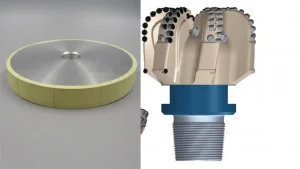
The resin bond diamond grinding wheel is the preferred choice. The resin bond offers excellent self-sharpening properties, allowing diamond particles to continuously protrude during grinding, ensuring sustained sharpness.

Due to the moderate retention force of the resin bond on diamond abrasives, the grinding path is more uniform, achieving a surface roughness of Ra 0.2–0.4 μm, which meets the requirement for a burr-free cutting edge.
The material of grinding wheel directly affects its roughness, toughness, and wear resistance, which further affects its cutting effect and wear during the grinding process.
For example, the hardness of metal bond grinding wheel is relatively high, and grinding wheel with different materials has different effect on the surface roughness of the workpiece during grinding
4. Precautions of Carbide Saw Blade Sharpening
4.1. Blade Resin Removal
During the use of carbide saw blades, adhesive from processed materials may accumulate on the blade. These residues must be thoroughly cleaned before sharpening.
Recommended method:Ultrasonic cleaning (optimal for complete residue removal without damaging the blade)
Not recommended:Manual removal using a power drill with a wire brush (risks blade surface damage and inconsistent cleaning results).
4.2. Saw Blade Stress Treatment and Flattening
During operation, the pre-tensioned stress on the saw blade body gradually diminishes. Additionally, friction with wood materials can cause deformation of the blade plate. These factors must be addressed during the sharpening process.

To ensure quality after sharpening carbide saw blades, it is imperative to perform flattening and stress restoration procedures. Never skip these steps for the sake of convenience. Each sharpening session should include inspection and correction of the blade’s flatness and stress values.
Critical benefits:Flattening reduces blade runout tolerance.Stress application restores blade rigidity and elastic properties.These procedures are essential for both standard and thin-kerf saw blades.
4.3. Saw Blade Angles
Manufacturers typically design specific angles for saw blades based on their intended applications, tailored to customer requirements. During the carbide saw blade sharpening process, it is crucial not to alter the original angles of the blade.
4.4 Control of Rake and Clearance Angles
Note that the ratio between rake and clearance angles should be maintained at 1:3. When measuring from the tooth base on the saw blade’s cutting edge, the remaining length and width must not be less than 1mm.
Operation Requirements of Carbide Saw Blade Sharpening:
Strictly follow standard operating procedures.Only trained professionals may perform the sharpening.Adhere to correct sharpening methods to ensure the saw blade remains functional within its intended service life.Improper sharpening will reduce cutting performance and blade quality
Critical Prohibitions:Never sharpen only the rake face or only the clearance face.This practice severely shortens the service life of carbide saw blades and negatively impacts subsequent sharpening results
4.5. Grinding Allowance for Saw Blades
During the use of saw blades, edge wear progresses through three distinct stages:
- Initial wear stage
- Normal wear stage
- Severe wear stage
It is critical to perform sharpening before the blade enters the severe wear stage. This requires:
Frequent communication with end-users
4.6 Professionalism and Stability of Specialized Grinding Equipment
The entire worn area must be thoroughly reground. Carbide saw blades should be sharpened using automatic sharpening machines. If conventional universal grinders are used for manual sharpening, inconsistent hand pressure and feed rates will compromise the sharpening quality.

In contrast, CNC sharpening machines ensure the rake face and clearance face are ground uniformly in the same direction.
4.7 Selection of High-Quality Resin Diamond Grinding Wheels
The quality of diamond grinding wheels significantly impacts sharpening results. For instance, premium diamond abrasives with resin bonds substantially enhance both cutting sharpness and wear resistance.
Key Benefits:
- Achieves higher tip precision rate during tooth sharpening
- Extends blade service life
- Critical Installation Consideration:
- A clearance space must be maintained between the tooth side and blade body to:
- Ensure tooth stability during grinding
- Prevent excessive wear on the grinding wheel
4.8. Chip removal groove
Try to ensure chip removal space and avoid grinding the chip removal groove at the same time as grinding the saw teeth. If the saw teeth are broken, you must go to the grinding center to change the teeth. When welding, use appropriate welding pieces or other solders. It is best to use a high-frequency welding machine and choose high-quality welding pieces.
4.9. The ultimate purpose of carbide saw blade sharpening:
The purpose is to make the saw blade reveal a new edge again, with the same sharpness and durability as a new saw blade.
The following picture is an enlarged photo of the back angle and side of the saw blade to be sharpened:

The saw blade to be sharpened in the above picture has a large amount of wear. It needs to be sharpened at the front and back angles, with the front angle being ground off by about 0.2~0.3 and the back angle being ground off by about 0.2~0.3. Only when the worn part is completely ground off can the saw blade be as sharp as before. If the grinding amount is less than the above value, even after grinding, the saw blade cannot achieve the best
4.10. Quality of carbide saw blade sharpening edge:
During the grinding process, low-end customers usually buy a grinding wheel and rub it by themselves, which is faster than not grinding. They rarely pay attention to the quality of the edge. In recent years, the quality of the edge has received more and more attention from high-end saw blade manufacturers. The focus is on the microscopic chipping of the edge. Generally, it is magnified 30~200 times to observe. This is easy to understand. If the edge is not complete, it will not be very sharp; if the chipped metal accounts for 10% of the worn metal, the durability of the saw blade will be reduced by 10%.

The above picture is a 180x magnified photo of the side blade surface of a saw blade manufacturer. The inspection standard is:The secondary cutting edge, blade tip, and rear cutting edge are required to have no obvious notches and chipping.
To achieve the above-mentioned chip-free edge, the requirements for the resin diamond grinding wheel are relatively high. The grinding wheel must be sharp, the equipment spindle must have no gap, the grinding wheel must have a suitable particle size (you can insert an article on how to choose the particle size of the diamond grinding wheel), and the grinding amount must also be appropriate.
4.11 Runout of Sharpened Saw Blades
After grinding, the saw blade should have the same radial accuracy as a new saw blade. Generally, the radial runout range of professional-grade saw blades is within 0.03, which puts forward certain requirements on grinding wheel consumption, equipment accuracy, positioning spindle, etc. It is necessary to measure the radial accuracy together with professionals.
Carbide saw blade sharpening may seem like a simple process, but in practice, it involves numerous critical details. The preferred method is to use CNC sharpening machines and high-quality diamond grinding wheels, strictly following the sharpening procedures.
Only by adhering to these standards can the resharpened carbide blades achieve the same sharpness as new blades, effectively reducing costs and maximizing economic benefits.