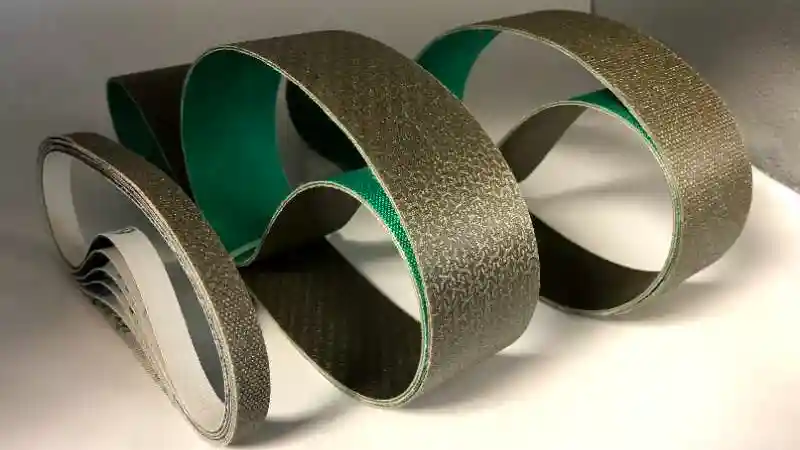
Selecting the right diamond abrasive belt for roller grinding can not only improve the grinding efficiency of the workpiece, but also improve the grinding quality of the workpiece. Diamond abrasive belts are particularly suitable for precision grinding of high-hardness materials, such as ceramic rollers, tungsten carbide rollers, alloy steel rollers, etc., due to their excellent wear resistance and cutting ability. Correct selection of abrasive belts can reduce processing time, reduce costs, and extend the service life of abrasive belts.
2 About The Material And Grinding Difficulties Of Rollers
2.1 Material OF Rollers
With the rapid development of new materials, ceramics, carbide and composite metal materials are widely used in high-end manufacturing fields such as aerospace, papermaking, and electronic packaging. However, these materials are extremely hard and difficult to process, which puts higher requirements on grinding tools.
The materials used in the manufacture of precision industrial rollers and wear-resistant parts are generally divided into the following categories:

Ceramic materials:
Alumina-based, zirconium-based, chromium-based (99.2% purity), yttrium-based, titanium-based
Cemented carbide:
Tungsten carbide, chromium carbide
Stainless steel material:
410/420 martensitic stainless steel
Composite material:
Ni-Si-B based steel wire + fused tungsten carbide (FTC) coating (particle hardness up to 2400 HV)
2.2 Difficulties in Grinding Rollers
These materials are not only hard, but also some workpieces have a diameter of up to 800mm. When using traditional abrasive belts, the grinding efficiency is low, the life is short, the processing temperature is high, and the surface is easy to burn.
- Oxide ceramics (Al₂O₃, ZrO₂, Cr₂O₃)
This type of material is corrosion-resistant, high-temperature-resistant, and has strong insulation properties. It is widely used in electronics, electrical, papermaking guide rollers, and other fields. It is brittle and prone to edge collapse, requiring high-precision grinding.
- Cemented Carbide (WC, Cr₃C₂)
Typical high-hardness, high-wear-resistant materials, commonly used in cutting tools, nozzles, rollers, etc. Due to high hardness, traditional abrasive belts wear quickly and have low grinding efficiency.
- Nickel-silicon-boron + molten tungsten carbide (FTC) composite coating
It is a thermal spray/hard surface welding coating system. The substrate hardness is 540 HV and the particles are 2400 HV. It is an extremely difficult structure to process. It is easy to produce work hardening, requiring the abrasive belt to have good heat dissipation and sharpness.
3 Why Choose Diamond Abrasive Belt For Roller Grinding
First of all, diamond abrasive belts have unparalleled hardness performance. The hardness of the abrasive is second only to natural diamond, and the Mohs hardness reaches level 10, which makes it easy to cope with the processing challenges of various ultra-high hardness materials. Whether it is extremely hard cemented carbide (HRA90 or above) or highly wear-resistant engineering ceramics, diamond abrasive belts can maintain stable cutting performance. In actual processing, even super-hard materials such as tungsten carbide and silicon nitride that are difficult to handle with traditional abrasive belts can be handled with ease by diamond abrasive belts.
Secondly, diamond abrasive belts are particularly suitable for wet grinding processes. When used with coolant, their unique abrasive distribution structure can achieve uniform heat dissipation and control the temperature of the processing area within an ideal range. This feature effectively avoids microstructural changes and dimensional deformation of the workpiece caused by high temperature, which is especially important for the processing of heat-sensitive materials such as titanium alloys and precision mold steels. Test data shows that under the same processing conditions, wet grinding with diamond abrasive belts can reduce the temperature of the workpiece by 30-40%, significantly improving the processing quality.
In terms of durability, diamond abrasive belts have an amazing service life. Compared with traditional aluminum oxide or silicon carbide abrasive belts, their wear resistance is improved by 5-8 times. This is mainly due to the extremely high hardness and excellent wear resistance of diamond abrasives. Taking the processing of cemented carbide as an example, under the same working conditions, the replacement frequency of diamond abrasive belts is only 1/5 of that of traditional abrasive belts, which not only greatly reduces the cost of consumables, but also reduces equipment downtime and improves overall production efficiency.
Diamond abrasive belts also have strong material adaptability. Their unique abrasive properties enable them to perfectly cope with the processing needs of various complex materials: from brittle ceramics to tough metals, from homogeneous materials to composite coatings, diamond abrasive belts can maintain stable processing performance. Especially when processing metal matrix composites (MMC) or ceramic matrix composites (CMC), diamond abrasive belts can achieve uniform removal of materials of different phases and avoid selective wear.

Finally, in terms of processing accuracy, diamond abrasive belts have unparalleled advantages. By precisely controlling the abrasive particle size and distribution density, nanometer-level surface roughness control (Ra can reach below 0.05μm) can be achieved. This high-precision processing capability makes it widely used in fields with extremely high surface quality requirements such as optical components, precision molds, and medical devices. At the same time, diamond abrasive belts can also maintain long-term stable cutting performance, ensuring high consistency of workpiece surface quality during batch processing.
4 How To Choose Diamond Abrasive Belt For Roller Grinding
When choosing a diamond abrasive belt for roller grinding, you should not only look at the material of the workpiece, but also consider the processing accuracy and processing method, so as to achieve the ideal processing effect.
4.1 Select the particle size according to the processing accura
Rough grinding and deburring: choose a coarse-grained sanding belt (#80~#150), which has strong cutting force and high efficiency and is suitable for preliminary forming;
Semi-finishing grinding and finishing: use a medium-grained sanding belt (#200~#400), taking into account both efficiency and surface quality;
Fine grinding and polishing: a fine-grained sanding belt (#600 and above) is recommended to improve surface finish and dimensional accuracy.
4.2 Select binder of diamond abrasive belt for roller grinding
In the actual processing process, the selection of binder needs to be closely coordinated with the processing method to achieve the best processing effect. For different processing environments, we recommend the following selection options:


For wet grinding, we recommend two bond solutions: electroplated bond diamond belt and resin bond diamond belt. Electroplated bond diamond abrasive belt for roller grinding is particularly suitable for large-scale continuous processing due to its excellent heat dissipation and stable grinding performance. Resin bond diamond belt is more suitable for precision processing scenarios with extremely high requirements for workpiece surface finish due to its excellent polishing effect and delicate surface treatment ability. In practical applications, when the workpiece surface roughness is required to be below Ra0.2μm, resin bond diamond abrasive belt for roller grinding can often show more excellent processing performance.

Electroplated bond diamond belts show unique advantages under dry grinding or partial cooling conditions. This type of bond has stronger mechanical strength and thermal stability, and can maintain stable grinding performance in the absence of sufficient cooling. Its special metal bonding structure can effectively resist the high temperature caused by dry grinding, ensuring the service life of the belt in harsh processing environments. Especially in some processing occasions where full immersion cooling cannot be achieved, such as partial grinding of large workpieces or on-site maintenance operations, electroplated diamond abrasive belt for roller grinding are often the most reliable choice.
Case Study
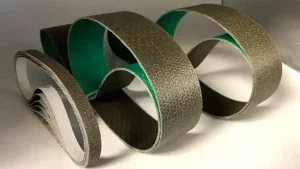
The 60mm×1200mm resin-bonded diamond abrasive belt we developed specifically for our customers uses a perfect combination of highly flexible resin bond and industrial-grade diamond abrasives, which is particularly suitable for fine grinding and polishing of high-hardness materials. This abrasive belt performs particularly well in wet polishing processes, effectively controlling the processing temperature through continuous cooling, and significantly improving the surface finish of the workpiece.


In practical applications, this diamond abrasive belt has demonstrated excellent processing performance and is widely used in the surface treatment of superhard materials such as ceramic coated guide rollers, tungsten carbide workpieces and composite metal coatings. Taking the processing of high-purity chromium oxide ceramics (Cr₂O₃ purity up to 99.2%) as an example, traditional abrasive belts often face problems such as low grinding efficiency and uneven surface quality. After using our resin diamond abrasive belt, not only the service life of the abrasive belt is extended by three times, but also the surface finish and consistency of the workpiece are significantly improved, which greatly reduces the time cost required for the subsequent polishing process, bringing tangible benefits to customers.


The excellent performance of this abrasive belt is due to its unique material ratio and process design: the resin binder gives the abrasive belt excellent flexibility, ensuring stable fit during processing; the industrial-grade diamond particles provide lasting cutting force; combined with the wet polishing process, it perfectly solves the problem of thermal deformation in the processing of high-hardness materials. The combination of these advantages makes it an ideal choice for high-precision surface treatment.
Diamond abrasive belts are ideal for roller grinding due to their high hardness, long life and excellent grinding performance. Correct selection of abrasive belt grain size, binder and substrate can significantly improve processing efficiency and quality. In practical applications, it is necessary to optimize the workpiece material, grinding stage and equipment conditions to achieve the best results.