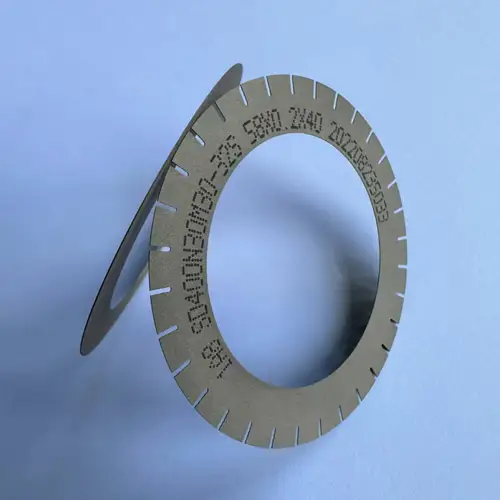
When cutting, the spindle drives the diamond dicing blade to rotate at high speed to obtain high rigidity, thereby removing the material to achieve cutting.
The dicing blade is composed of synthetic diamond and bonding agent. It is used for cutting off, fluting of metal, ceramic, or semiconductor wafer under the high speed rotation of the spindle of the dicing equipment. It has high precision, good stability, and high efficiency.
Diagram of Blade Components:
Diamond Dicing Blade
Application:
Glass, crystal, quartz, LiTaO3, various semiconductor packaging components, ceramics, silicon nitride (Si3N4), silicon carbide (SiC), crystal, sapphire, silicon wafer, semiconductor compound wafer, chip LED substrates, gallium arsenide, and other materials.
Blade For Cutting QFN Package
Blade For Cutting PCB
Blade For Cutting DFN Package
Blade For Cutting EMC Package
Blade for Cutting Metal Oxide Film Resistor
Blade for Cutting Optical Glass
Blade for Cutting Ceramic Substrates
Blade for Cutting LED Package
3-Blade Type By Bonder
According to the bonding agent,it is divided into resin bond, metal bond, and electroplated bond blade.
Resin Bond Diamond Dicing Blade
Resin Bond Diamond Dcing Blade
The resin bonding agent has good elasticity and polishing effect.
When combined with diamond abrasive to make resin diamond dicing blade, it still has good self sharpness, not blocked, and less dressing.
It is usually used for cutting packaging substrates, ceramic, glass and other materials. However, resin bonding agent has poor holding force on abrasives and poor heat resistance, resulting in significant blade wear during high temperature cutting.
Bronze Metal Bond Diamond Dicing Blade
Bronze bonding agent is usually made of bronze and tin. Add some metal powders such as silver, nickel, zinc, etc to change the performance.
Metal Bond Diamond Blade
Mix the above metal powder and diamond powder thoroughly, then place them in the mold to press and profile them, and sinter them to form the metal bond hubless dicing blade.
The bonding strength between the binder and abrasive particles of this type of dicing blade is high, and the wear resistance is good, and the wear is small, so the life is long and it can maintain good shape, and it can withstand large load.
But the disadvantage is poor self sharpening, easy surface blockage, large heat, and difficult to dressing.
It is mainly used for cutting non-metallic materials such as glass, ceramic, and semiconductor.
Specification Of Hubless Blade
Electroplated Diamond Dicing Blade
The bonding strength of electroplated binder is high. Usually, a single layer of abrasive particles is electroplated onto the metal substrate.
This electroplated diamond dicing blade has thin abrasive layer, high abrasive density, sharp cutting, high cutting efficiency, good economic benefits, and not dressing. It is mainly used for cutting wafer.
Hub Electroplated Wafer Dicing Blade
Hubless Electroplated Blade
The Parameter of Hub Electroplated Blade
Blade Type By Structure
According to the structure, it can be divided into hub dicing blade and hubless dicing blade
The hubless blade needs to be fixed with the flange. The advantages include a large amount of blade exposure which can cut thicker products. It needs to replace the flanges for continuous use and it has high cost-effectiveness. However, after using this fixed method, the dicing blade needs to be dressed to achieve the true circular effect. And the contact part between the blade and flange will have slight jumping, which affects the cutting effect.
Hub Electroplated Diamond Blade
Hubless Metal Diamond Blade
Hubless Resin Diamond Blade
The hub blade is fixed to the special flange by high temperature and high pressure, and can be confirmed as the true circle before leaving the factory. Due to the fusion of the blade body and flange, it can process high quality products, but the production method determines that the exposure of the blade cannot be too large. The hub dicing blade can not cut the thicker products.
Features of Hub Blade VS Hubless Blade
Differences in Appearance
Generally speaking, a single circular thin grinding wheel is called a hubless dicing blade, while the grinding wheel combined with an aluminum alloy tool holder is called a hub dicing blade.
Differences in Bonding Agents
The bonding agent of diamond hubless blade is usually metal nickel alloy, metal copper alloy, or resin, while the bonding agent of diamond hub blade is usually only metal nickel alloy (electroplated process).
Differences in Manufacturing Technology
When manufacturing hubless diamond blade, the profiling method usually include electroplated, powder pressed sintered, or powder pressed heating solidification. The hub diamond blade is usually profiled by electroplated.
Electroplated Blade
Differences In Usage Methods
When using diamond hubless blade, it must be positioned and fixed on the special cutting disc( or flange), and then installed on the cutting machine. When using hub blade, it can be directly installed on the cutting machine without the cutting disc.
Differences In Common Specifications of Dicing Blade
Hubless blade inner diameter: usually 40mm, or 88.82mm
Hub blade inner diameter: 19.05mm
Hubless blade thickness: 0.04-1.5mm
Hub blade thickness: 0.015-0.150mm
We also provide customized services and produce blades according to customer’s required sizes.
Sintered Resin and Metal Blade
Differences In Application
Hubless type blade: various semiconductor packaging materials such as ceramic, glass, sapphire, ferrite, lithium niobate monocrystalline.
Hub type blade: various types of wafer
Cutting Process of Dicing Blade
Diamond blade plays a cutting role on the cutting edge, which has countless abrasive particles that can cut the workpiece.
When the cutting edge first comes into contact with the workpiece, the cutting force gradually increases from small to large. At this time, the abrasive particles do not cut the workpiece, but only slide past its surface, and the workpiece only undergoes elastic deformation.
Cutting Process of Dicing Blade
As the abrasive particles continue to penetrate the workpiece, the surface of workpiece begins to plastic deformated. The material compressed in front of the abrasive particles undergoes plastic deformation on both sides, plowing grooves on the surface of workpiece, and the two sides of the grooves slightly protrude to produce fractures.
The abrasive particles continue to cut into the workpiece, and the vertical force cutting downwards increases continuously. When reaching the critical value, the material debris that is squeezed and broken by the abrasive particles is washed out of the groove through the blade edge flute and cooling water, achieving the purpose of removing the material.
Dressing of Diamond Dicing Blade
During the cutting process, diamond dicing blade continuously wears out and exposes new diamond abrasive particles, which continue to participate in grinding to maintain sufficient sharpness and stable cutting effect. We call this process self sharpening.
Blade Wear Diagram
However, when cutting the workpieces with different materials, the self sharpening performance of the dicing blade varies. When the self sharpening performance of the diamond blade is insufficient, it can be dressed to expose the diamond, achieving the stable and good cutting effect.
In addition, after installing the dicing blade, there is a deviation between the center of the blade and the center of the spindle, resulting in eccentricity. When rotating at high speed, it is not really circular.
The larger the eccentricity, the larger chipping size on the back for initial cutting. So the cutting quality can be better after pre cutting with one new diamond blade.
Parameter of Dressing Board
Related Products
Hubless Metal Diamond Blade
Resin Bond Diamond Dcing Blade
Hub Electroplated Diamond Blade
Dicing Blade Dressing Board
INQUIRY
Please Feel free to give your inquiry in the form below. We will reply you in 24 hours.