When it comes to cutting high borosilicate glass, conventional cutting tools wear quickly and are inefficient when cutting high borosilicate glass, making them unsuitable for precision-critical industrial applications. In high-end manufacturing, even small deviations in cutting parameters or the choice of diamond cut of wheel can result in edge chipping, non-vertical cuts, and reduced dimensional accuracy.
For best results, it is recommended to use professional diamond cut off wheel in combination with a sophisticated cooling system to ensure precision cutting quality and save economic costs.
In addition, frequent replacement of diamond blades can significantly increase operating costs. These ongoing issues are a key pain point for manufacturers seeking reliable and cost-effective glass cutting solutions.
About High Borosilicate Glass
High borosilicate glass is a special glass with silicon dioxide (SiO₂) and boron trioxide (B₂O₃) as the main components, of which the boron content is usually 12%-30% and the silicon content is 65%-80%.
High borosilicate glass is used in the following fields where precision cutting is required:
Laboratory: Customized high-precision glass instruments to meet the needs of scientific research experiments.
Photovoltaic / semiconductor: Processing special glass to help produce key components.
Pharmaceutical chemicals: Used in the manufacture of medical ampoules and chemical reactors to ensure product quality.
Method for Cutting High Borosilicate Glass
3.1Precision Dicing Machine
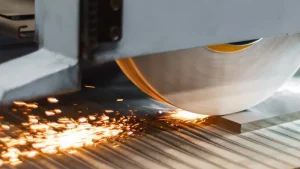
The diamond dicing blade is driven by an air static pressure electric spindle, which slices the glass at a speed of tens of thousands of revolutions per minute, while the worktable moves at a constant speed to complete the cutting. This method can achieve micron-level accuracy and is suitable for large quantities of single-shaped high borosilicate glass.
3.2 Diamond Wheels For Cutting High Borosilicate Glass
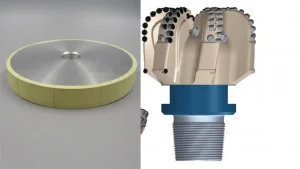
Sintered diamond cutting off wheelsare used in combination with metal powders such as bronze. They have the characteristics of strong wear resistance and long service life. They are especially suitable for rough processing of hard and brittle materials such as glass and ceramics (such as 1A1R diamond cutting blades). There are two types of binders: resin and metal binders.
3.3 Laser cutting and post-processing
For complex shapes or high-precision requirements, a laser cutting machine can be used for preliminary cutting, and then mechanical grinding, polishing and surface coating processes can be used to optimize light transmittance and flatness.
Among these types, the most commonly used resin-bonded diamond cutting blades are analyzed in the following chapters.
Why Resin Diamond Cut Off Wheel?
Commonly used diamond cutting off wheel are resin and metal. If you want to reduce the edge collapse rate, the resin diamond cutting wheel is the first choice. The resin binder has its own elastic buffer, which can effectively reduce edge collapse and burrs, and the cross-section of the cut glass tube is flat and smooth. Resin cutting discs can be made thinner.
Metal-Diamond-Cut-off-Wheels
Resin-Diamond-Cut-off-Wheels
Regardless of the diameter of the glass tube or the precision requirements, exclusive cutting discs can be customized to meet diversified processing needs. Cutting discs developed for the field of glass deep processing perform well in cutting materials such as high borosilicate glass tubes and quartz glass.
Resin diamond cutting discs use high-quality diamond abrasives and high-quality resin binders. They have high cutting efficiency, long service life, and reduce the frequency of replacement, helping you save a lot of time and cost.
Summary Of Cutting High Borosilicate Glass
Selecting a resin bond diamond cutting blade is only one direction. The most important thing is the production formula and process. Selecting high-quality diamond and resin raw materials is the basis of a high-quality cutting blade. High-quality resin diamond cutting blades for cutting high borosilicate must have the following characteristics.
Stable cutting: The cutting blade substrate has good rigidity, the cutting process is stable, and the verticality of the cross section is guaranteed.
Fine grinding: Using a fine-grained abrasive formula, both cutting efficiency and surface finish can be taken into account.
Strict quality control: From raw materials to finished products, the quality is controlled throughout the process, and each cutting blade performs consistently.