How to design an electroplated diamond grinding bit for 2.5D glass is a crucial yet challenging problem.
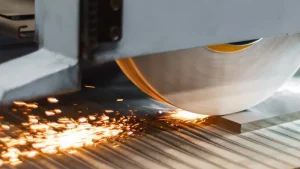
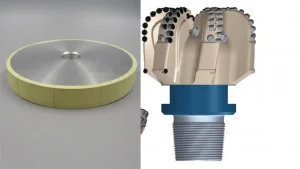
Electroplated diamond grinding bits(It is also a small electroplated diamond grinding wheel) play an irreplaceable role in processing 2.5D smartphone glass, such as grinding operations on glass covers/back panels, including drilling and chamfering, edge grinding and chamfering, as well as 2.5D or 3D forming.

However, if the design of the electroplated grinding bit is unreasonable during actual processing, issues like scratches on the grinding surface and the formation of steps that are difficult to remove after polishing may occur.
About 2.5D Glass
The term “2.5D screen” is a widely used industry term referring to glass with a flat central area and curved edges, meaning the flat glass undergoes additional arc processing along its perimeter.
Compared to traditional 2D screens, 2.5D screens involve more complex manufacturing techniques, leading to higher costs. During processing, uneven grinding transitions can occur, resulting in a lower yield rate. In terms of cost, a single 2.5D glass panel is approximately 3–4 times more expensive than standard flat glass. Although the price difference isn’t extreme, manufacturers typically reserve this technology for high-end flagship devices.
3.Common Issues of Electroplated Diamond Grinding Bit For 2.5D Glass
Before manufacturing diamond grinding bits for 2.5D glass, the electroplated grinding bit must be designed to match the contour of the 2.5D glass curved surface. Typically, the finished arc contour width falls within the range of 1.2mm–2.5mm, while the CNC-processed electroplated grinding bit usually has a width of 0.9mm–1.8mm.

Issue 1: 2.5D Grinding Wheel Lines
When designing electroplated diamond grinding bits( small electroplated diamond grinding wheel), manufacturers often directly replicate the glass profile from CAD drawings. However, most glass profiles are composed of polyline segments, where connection points between segments create abrupt transitions. This leads to wavy contour formation during lathe machining of the grinding bits.
After electroplating, uneven diamond distribution occurs, particularly at height-variation point where abrasive particles fail to fill smoothly. During glass processing, there are many visible line on the glass surface, and the wide arc width is large, impeding coolant flow, reducing chip evacuation efficiency, aggravating scratch formation on the ground surface.
Issue 2: 2.5D Step formation
Electroplated diamond grinding bits are typically designed by replicating the glass contour.However, without a thorough understanding of the electroplating diamond deposition process, designers often set the wheel’s arc width based on the original drawing’s maximum tolerance (generally ≤0.2mm).

While this design is theoretically sound, the electroplating process for diamond tools introduces critical challenges related to uneven current distribution and tip discharge effects. During electrodeposition, the electrical current and electrolyte solution work synergistically to decompose nickel ions, which subsequently anchor and reinforce the diamond particles.
Due to the causes of excessive current between the sharp corners and surfaces, it creates accelerated nickel deposition. This results in localized thickness variations of 0.01-0.02mm.The degree of dimensional deviation varies across product structures.
Case Study Of Electroplated Diamond Grinding Bit For 2.5D Glass
Example: When processing a 1.8mm wide arc glass, the grinding head is designed to have a 2.18mm wide arc. After electric sanding, the Z-direction spacing is only 0.01mm reserved, and the effective width in the XY direction is 0.13mm. In this way, after CNC processing, if the base surface is raised, the arc surface will form a 2.5D step with the plane difference, and it will be judged as NG.

Summary and Improvement Measures
The above two common 2.5D problems can be avoided by considering the characteristics of the electroplating process in advance when designing the grinding head, and adjusting the design appropriately to avoid unnecessary grinding problems and the scrapping of workpieces; it can be seen that in addition to the grinding performance of the electroplated diamond grinding head itself, better design and comprehensive system solutions can bring better processing results.
For many years, Newdiamondtools Company has been adhering to the concept of providing customers with comprehensive grinding system solutions and making all grinding simpler, so as to provide customers with better design and more cost-effective superhard products.