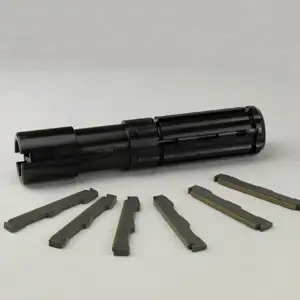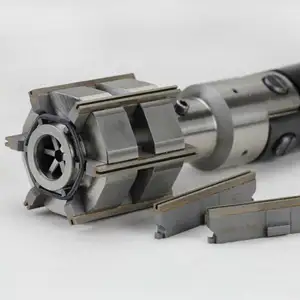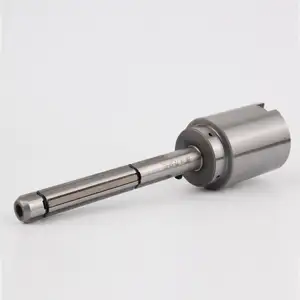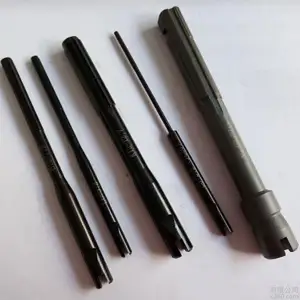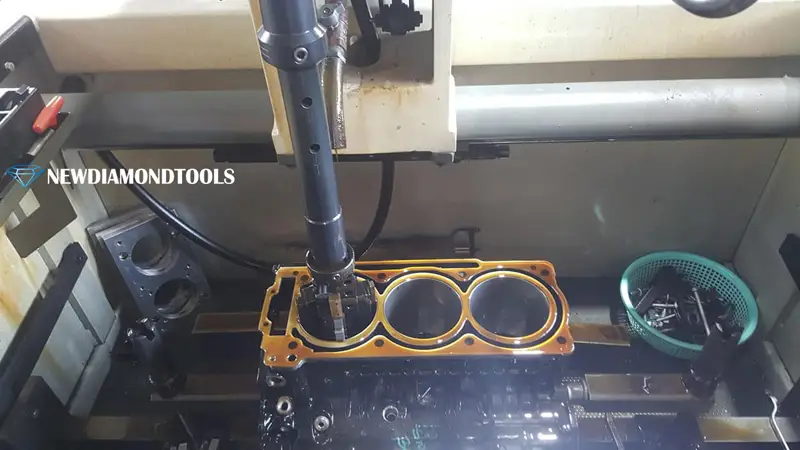
In the process of precision honing, the selection of the grain size of the cylinder honing stone directly affects the surface roughness of the workpiece, machining efficiency and the service life of the tool. Customers usually propose initial grain size requirements based on past experience, but may encounter various problems in actual testing, such as substandard roughness, insufficient service life or poor self-sharpening.
This article will analyze the common problems and optimization solutions in the selection of grain size for superhard material honing sticks based on actual cases.
(1) Applicable Scenarios Of CBN
Best processing materials: hardened steel (HRC > 45), high-speed steel (HSS), cast iron (gray cast iron, ductile iron), heat-resistant alloys (such as Inconel)
Inapplicable materials: aluminum alloy, copper and other soft metals (easy to clog), non-metallic materials (such as ceramics, glass


(2) Diamond Application Scenarios
Best processing materials: cemented carbide (WC-Co), ceramics, glass, silicon carbide, titanium alloy, composite materials
Unsuitable materials: iron-based materials (prone to chemical wear)
Of course, this is not 100% absolute. For related reading:2025 Choose Stone of Honing Stainless Steel? Diamond Or CBN
2.Initial Grit of Honing Stone Requirement
Customers usually propose an initial honing stone grit requirement based on their previous experience in processing cylinder similar workpieces. For example, if a customer has used 600# honing stones to achieve good surface quality in the past(Target roughness is Ra0.15μm-0.5μm), they may prefer the same or similar grit in a new project. However, due to differences in materials, processing parameters or precision requirements, the initial grit may not be completely applicable and needs to be verified through actual testing.
3. Key Issues In Actual Testing
After the first round of testing, generally speaking, the following two situations will occur:


3.1 Customer Satisfaction
If the test results meet expectations (such as surface roughness meets the standard and processing efficiency is high), it means that the initial particle size is reasonably selected and can be directly put into production.
3.2 cylinder Roughness Does Not Meet The Standard
3.2.1 Too High Roughness Of Cylinder
Reason: The grain size of the honing stone is too coarse, resulting in excessive cutting force and obvious surface scratches.
Solution: Use a finer grain size (such as changing from 600# to 800#), or adjust the cutting parameters (such as reducing the feed speed).
3.2.2 Too Low Roughness Of Cylinder (Over-Polishing)
Reason: Too fine grain, insufficient cutting capacity, resulting in low processing efficiency, or even ineffective material removal.
Solution: Use a slightly coarser grain size (such as from 600# to 500#), or increase the honing pressure to enhance cutting capacity.
3.3 Other Problems After The Roughness Meets The Requirements
Even if the roughness meets the requirements, the following problems may still occur:
3.3.1 Life Problem of Cylinder Honing Stones
Phenomenon: The honing strip wears too quickly, and frequent replacement affects production efficiency.
Optimization direction:Use a binder with higher wear resistance (such as metal binder instead of resin binder).
Adjust the particle size distribution to avoid abnormal wear caused by too soft or too hard abrasives, or increase the grade of diamond or CBN abrasives to increase the life of the honing strip.

3.3.2 Self-Sharpening Problem Of Cylinder Honing Stones
Phenomenon: The honing bar is passivated too quickly, the cutting ability decreases, and the honing bar becomes blocked, causing the tool to lose its sharpness. After pressurization, accumulation occurs, affecting the processing effect.
Optimization direction:Choose abrasives with good self-sharpening properties (such as CBN or diamond).
Optimize the structure of the honing bar (such as increasing the porosity and promoting the shedding and renewal of abrasive particles).

3.3.3 Stability Problem Of Cylinder Honing Stones
Phenomenon: poor processing consistency, large fluctuations in the surface quality of workpieces in different batches.
Optimization direction:Strictly control the manufacturing process of honing bars (such as abrasive uniformity and bond strength).
Optimize coolant parameters (such as flow rate and lubricity), reduce the impact of thermal deformation, control the grade of diamond (CBN) abrasives, ensure the stability of each batch, and also include the quality control of the bond, which is also a very important aspect.
The selection of the grain size of the honing stick is not fixed and needs to be adjusted in combination with material properties, processing requirements and actual test results. While meeting the roughness requirements, key factors such as life, self-sharpening and stability must also be considered. Through reasonable grain size optimization and process adjustment, the processing efficiency and product quality can be significantly improved.
(This article is based on actual case summary and is suitable for the honing of high-precision parts such as automobile cylinder blocks and hydraulic valve bodies.)