In honing stainless steel workpieces, CBN honing stones are the preferred tool, but this is not the only choice. Diamond honing stone are also an option.
Honing Stone Specifications
People who have worked in the grinding industry for many years know that during the grinding process, diamonds will carbonize with carbon elements under high temperatures, resulting in the inability to perform normal grinding. However, in the actual grinding process, in very few scenarios, diamond honing stone have better grinding quality than CBN honing stone.
About Honing
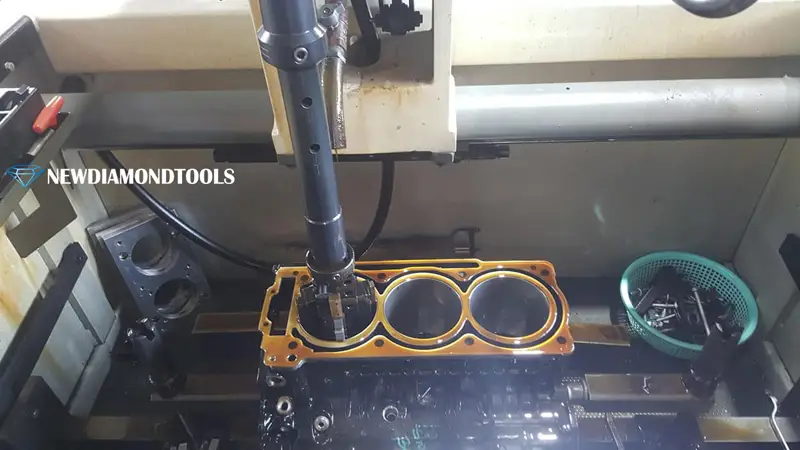
Honing is an efficient precision machining method based on the grinding principle. Its characteristic is to achieve fine machining of the workpiece surface under low-speed cutting conditions. As a special grinding process, honing can not only efficiently remove large machining allowances, but also significantly improve the dimensional accuracy and geometric accuracy of the workpiece and reduce the surface roughness. Therefore, it has a wide range of application value in the field of automotive parts manufacturing.
Excellent accuracy of honing stainless steel
The honing process performs well in shape accuracy control, especially for small and medium-sized through-hole processing, and can achieve a cylindrical accuracy of 0.001mm. For parts with uneven wall thickness (such as connecting rods), the roundness accuracy can reach 0.002mm. In the absence of annular grooves or radial holes, the straightness can be controlled within 0.01mm/1m. Compared with traditional grinding, honing has obvious accuracy advantages, mainly because the grinding wheel bearing is located outside the processing hole during the grinding process, which is prone to deviation, especially when processing small holes.
Excellent surface quality of honing stainless steel
The honing surface presents a unique cross-net texture, which is conducive to the storage of lubricating oil and the maintenance of oil film. Its high surface support rate (the ratio of actual contact area to matching area) makes the workpiece have stronger load bearing capacity and wear resistance, thus significantly extending the service life of the product. Due to the use of low-speed processing and surface contact, the cutting pressure of a single abrasive grain is small, and the temperature of the processing area is maintained between 50-150℃, which effectively avoids thermal damage to the workpiece surface and the formation of a metamorphic layer, ensuring that the processing deformation is minimized.
Wide range of processing adaptability
This process is mainly suitable for processing various cylindrical holes, including through holes, discontinuous holes with radial holes or slots, keyway holes, spline holes and blind holes. Special honing heads can also be used to process complex surfaces such as conical holes and elliptical holes. Although external honing is less used due to the complex tool structure and the removal of excess is less than that of internal honing, it is still an effective processing method.
Replacement of Sunnen Honing Stone
Single Pass Honing Tools
Replacement of Sunnen Honing Mandrel
Honing Adapter
Micro-cutting characteristics of honing stainless steel
As a finishing process, honing has the smallest single cutting allowance among all processing methods. Its processing principle is to use the honing tool to guide the workpiece and accurately remove micro-materials to achieve the predetermined accuracy requirements.
Excellent correction capability of honing stainless steel
For common hole processing defects in mechanical processing (such as roundness deviation, bell-shaped holes, corrugated holes, insufficient size, drum-shaped holes, tapered holes, boring marks, hole position deviation and surface roughness), the honing process can significantly improve the key quality indicators such as dimensional accuracy, roundness, straightness, cylindricity and surface finish of the inner hole by removing extremely small amounts of excess material.
About Honing Stones
Composition and Function of Honing Stones
Honing stones are the core tools in the honing process, usually composed of three parts: abrasives, binders and pores:
Abrasives: are the main components of honing stone, responsible for direct contact with the workpiece surface and cutting. The particle size, hardness and toughness of the abrasives determine the efficiency, precision and surface quality of the processing. Abrasives include diamond, CBN, silicon carbide and other abrasives.
Diamond Honing Sticks For Stainless Steel
CBN Honing Stone For Stainless Steel
Binder: used to bond the abrasives into stone to ensure the stability and self-sharpening of the abrasives during the processing. The strength of the binder needs to be sufficient to ensure the stability and durability of the abrasives during the processing. Commonly used are metal binders and resin binders.
Pores: The gap between the abrasive and the binder, the main function is to help remove the grinding chips and dissipate heat.
Diamond Honing Stone VS CBN Honing Stone
Diamond abrasives: Stainless steel is more difficult to cut during processing. Due to its hardness and toughness, diamond abrasives are usually more suitable for stainless steel processing. Diamond, as an extremely hard material, can easily cut the surface of stainless steel with less scratching problems.
However, because diamond can carbide with carbon elements at high temperatures, the grinding process is not easy to take too long, and sufficient grinding fluid must be ensured to take away the heat of grinding. Therefore, in conventional stainless steel processing that has not been heat treated, diamond abrasives are an ideal choice. For example, using diamond honing stone to process 316 stainless steel hydraulic cylinders can achieve good grinding results.
CBN abrasives: CBN is mainly used for honing heat-treated stainless steel, especially materials with a hardness exceeding HRC40°. If the customer’s workpiece has been heat-treated and has a high hardness, CBN abrasives will be a more suitable choice. CBN has excellent high temperature resistance and can cope with materials with higher hardness, providing stable processing results.
CBN honing sticks should be used first for grinding stainless steel, because their high temperature resistance and chemical reaction resistance are more suitable for stainless steel processing needs; diamond is limited to local processing of special composite materials.
Comparison Table of Honing Surface Roughness
The actual selection should also be optimized in combination with the specific stainless steel type (such as ferrite, austenite) and process requirements (rough grinding/fine grinding). If the workpiece is ordinary stainless steel material, diamond abrasive can provide better results. However, if the workpiece has a higher hardness and has been heat treated, CBN abrasive can more effectively avoid wear and damage during processing.