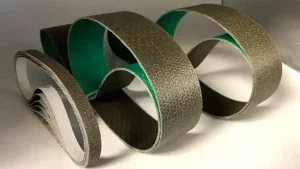
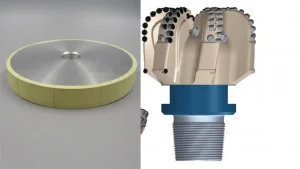
In the experiment of dicing K9 glass, three kinds of binders, metal, resin and electroplated, were selected, and it was concluded that resin diamond dicing blade for K9 crystal glass is best choice.
On the high-precision dicing machine, the cutting test of K9 optical glass was carried out by adjusting the clamping and fastening method, the type of blade, and the amount of cutting water.
The test results show that among the three fastening methods, the glass substrate has the best fixing effect, followed by the UV film, and the high-temperature silicone tape has a relatively poor fixing effect. In terms of the type of dicing blade, the resin hubless diamond dicing blade has the best cutting performance, with the smallest chipping width and the lowest surface roughness; the metal hubless diamond dicing blade has a medium performance, and the electroplating dicing blade has the worst effect.

The effect of cutting water flow on processing quality shows obvious regularity: with the increase of water flow, the width of chipping and surface roughness gradually decrease. When the water flow reaches above 4.5L/min, the cutting effect tends to be stable, and further increasing the water flow does not significantly improve the quality.
what Is K9 Crystal Glass
K9 optical glass is widely used in the optical industry due to its excellent physical and chemical properties, including high hardness, good optical transparency, stable refractive index, and outstanding material homogeneity.
As a typical hard and brittle material, it presents significant challenges in processing. In practical applications, K9 optical glass requires precision cutting to achieve specific dimensional specifications. Particularly for the manufacturing of high-end optical components, the requirements for cutting processes are extremely stringent.

Defects such as excessive edge chipping or micro-cracks generated during processing can directly impair the optical performance of the product and, in severe cases, even lead to the rejection of entire batches. Therefore, controlling cutting quality is a critical step in ensuring the performance of K9 optical glass products.
Principle of Dicing Blade For K9 Crystal Glass
The K9 crystal glass dicing process involves using a dicing machine to divide a whole piece of glass into individual products. Its working principle and structure are illustrated in the figure. This process primarily relies on two material removal mechanisms: brittle fracture and plastic deformation.
In the brittle fracture removal process, material is removed through void formation, crack propagation, spalling, and fragmentation. Specifically, abrasive grains create flaws on the glass surface, which first appear in the contact zone behind the abrasive and then expand laterally, forming micro-cracks. When the cutting force exceeds the material’s ultimate strength, edge chipping occurs, as shown in Ⅰ and Ⅱ in the figure.

Plastic deformation removal, on the other hand, includes three modes: rubbing, plowing, and chip formation. In this process, the diamond dicing blade interacts with the optical glass surface, and the friction from abrasive grains causes elastic deformation in the material. Due to internal friction, a plastic deformation zone forms beneath and ahead of the abrasive grain. As the X-axis continues to feed, this plastic zone expands and forms a shear zone, eventually removing material in the form of chips to create the dicing kerf, as shown in Ⅲ and Ⅳ in the figure.
First, the K9 glass is fixed onto a glass substrate and then placed on the worktable. Above the worktable, a CCD industrial camera is installed, which can move along the Y-axis to precisely locate the glass position and cutting path. The worktable is driven by a θ-axis motor, enabling free rotation within a 400° range.

During cutting, the blade holder on the air-bearing electric spindle clamps the dicing blade to perform the cutting. The spindle is mounted on the Z-axis, allowing adjustment of the cutting depth through vertical movement. The diamond blade follows the preset speed and performs uniform, periodic dicing along the cutting path. The X-axis controls the movement along the length of the cutting path. After each dicing pass, the Y-axis moves a certain distance to proceed to the next cut. Finally, the θ-axis rotates 90 degrees to achieve cross-cutting in different directions.
The entire machining process is completed by the coordinated cooperation of various axes. The specific structural diagram is shown in the figure.
Slice test conditions and methods of of Dicing Blade For K9 Crystal Glass
A systematic single variable experiment was conducted using high-precision and high-efficiency dicing equipment to deeply explore the influence mechanism of different processing parameters on the edge chipping width and surface finish of K9 glass.

The sample material is K9 optical glass, and its performance parameters are shown in Table
The selection of diamond dicing blades requires comprehensive consideration of key indicators such as tool life, processing quality and economic cost. Among them, diamond abrasive particle size and binder material are the core factors affecting tool performance. To this end, this study conducted a systematic comparative experiment on three typical blades with metal binders, resin binders and electroplating binders. The specific process parameters are shown in the following table.

Experimental plan of Dicing Blade For K9 Crystal Glass
This study employs a single-factor experimental method to systematically analyze the influence of different process parameters on the dicing quality of K9 crystal glass. Three key parameters were selected for testing: clamping method, dicing blade type, and cutting water flow rate, while other process parameters remained constant (see Table 3).
The experiments were conducted in three groups:
- The first group examined the impact of clamping methods by comparing the dicing effects of three fixation approaches: high-temperature silicone tape, UV film, and glass substrate.
- The second group investigated the influence of dicing blade types, testing the performance differences among metal dicing blades, electroplated dicing blades, and resin dicing blades.
- The third group evaluated the effect of cutting water flow rate, with different flow levels set at 1.5 L/min intervals within the range of 1.5-6.0 L/min.

Through these experiments, the study aims to determine the effects of each parameter on the chipping width and surface roughness of K9 optical glass, providing a basis for optimizing the dicing process.
By conducting these single-factor experiments, the study systematically evaluates the impact of each parameter on the cutting quality of K9 optical glass, offering experimental evidence for process optimization.
Analysis and Conclusion of Dicing Blade For K9 Crystal Glass
4.1 The clamping method significantly affects the dicing of K9 optical glass. The glass substrate clamping yields the best results, followed by UV film, while high-temperature silicone tape performs poorly.
Analysis:
During processing, K9 glass is typically secured to the workpiece stage using adhesive films (such as high-temperature silicone tape or UV film) or wax. The adhesive film must provide sufficient tackiness to prevent material detachment during dicing while remaining easy to remove afterward.
High-temperature silicone tape (green film) is relatively soft. When securing K9 glass, it tends to trap air bubbles and generates significant tensile stress, leading to increased chipping and surface roughness. UV film helps reduce edge chipping during dicing, prevents glass displacement or falling, and becomes less adhesive after UV exposure, facilitating removal. However, like silicone tape, UV film is a soft-contact method and still causes some deformation during dicing, affecting machining quality.

In contrast, securing K9 glass to a substrate glass with wax provides better support, minimizes lateral displacement, and optimizes stress distribution, thereby reducing chipping. Additionally, the substrate glass exhibits self-dressing properties, lowering cutting resistance. Experiments show that when the cutting depth is 1.2 mm, the kerf is smoother. Therefore, the glass substrate clamping method effectively improves the dicing quality of K9 glass, reducing chipping and surface roughness.
4.2 When using resin-bonded dicing blades for glass cutting, the chipping width is smaller and the surface roughness is lower, resulting in better cutting performance compared to metal blades, while electroplated blades perform the poorest.
Analysis:
Different types of dicing blades have distinct characteristics. Metal-bonded dicing blades offer strong cutting force, excellent wear resistance, and long service life; electroplated diamond dicing blades exhibit good toughness and high precision, making them suitable for demanding machining tasks; resin-bonded blades wear vertically, reducing grain deformation and improving machining quality.


For hard and brittle materials like K9 glass, resin-bonded diamond dicing blades are more suitable. Their relatively soft composition allows worn abrasive grains to shed promptly, maintaining sharpness. Practical tests show that such blades offer advantages such as good elasticity, strong self-sharpening ability, and high efficiency. Using resin-bonded blades effectively reduces chipping during glass cutting while lowering surface roughness.
4.3 As the cutting water flow rate increases, the chipping width and surface roughness of the glass gradually decrease. When the cutting water flow rate exceeds 4.5L/min, the cutting effect tends to stabilize.
Analysis: Experimental results demonstrate that controlling the cutting water flow rate significantly impacts the dicing quality of K9 glass. Insufficient water flow leads to inadequate cooling, accelerating blade wear and potentially causing scorching issues; excessive water flow may cause kerf deviation, uneven cutting paths, and could wash away insufficiently bonded materials – particularly reducing the rigidity of thin blades.


In the process dicing blade for K9 crastal glass, the functions of the coolant include:
Taking away the heat generated by the friction between the dicing blade and the material;
Removing chips;
Preventing heat from affecting material properties;
Extending the service life of the blade.
Taking all factors into consideration, controlling the cutting water flow rate at 4.5L/min can effectively optimize the cutting quality of K9 glass and ensure that the chipping width and surface roughness meet the requirements.
By optimizing the process parameter combination, the best K9 optical glass cutting effect can be obtained by using the glass substrate fixing method, resin diamond dicing knife and 4.5L/min cutting water flow. Under this condition, the measured edge collapse width is 5.8μm, and the surface roughness Ra value is 10.5nm, which fully meets the processing requirements of precision optical components.
Refer to the picture below for the actual picture of K9 optical glass before and after cutting.