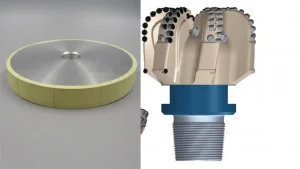
Regarding the selection of cylindrical diamond wheel for PCD reamer, vitrified bond diamond grinding wheels are often selected. Commonly used grinding wheel models are 3A1 and 14A1, and commonly used grinding wheel diameters are 300, 350, and 400 mm.
About Cylindrical Diamond Wheel For PCD Reamer Grinding
The use of external cylindrical grinding technology to process PCD reamers can form a high-precision micro-texture structure on their surface, significantly improving the surface quality of the tool. This process can make the surface finish of the reamer reach Ra0.1μm or less, and the roundness error is controlled within 1μm, which fully meets the technical requirements of precision machining. By optimizing the grinding parameters, not only the geometric accuracy of the PCD tool is improved, but also its overall cutting performance is significantly improved.

Since PCD materials have extremely high hardness (microhardness can reach 8000HV), there are special technical difficulties in grinding: the material removal efficiency is extremely low (only 0.01% of cemented carbide), and the grinding process optimization, dimensional accuracy control and processing efficiency improvement in the tool edge preparation process all face major challenges. These characteristics make the precision manufacturing of PCD tools an important research topic in the current field of superhard tools.
About PCD Reamer
PCD reamer (Polycrystalline Diamond) is a superhard tool that uses a carbide or steel matrix as a support and welds a polycrystalline diamond (PCD) composite sheet on the cutting edge. With its excellent cutting performance, PCD reamer is widely used in precision machining fields such as 3C electronics, automobile manufacturing, and aerospace.
Advantages and characteristics of PCD reamer
(1) PCD reamer has ultra-high hardness and wear resistance;
(2) The use of PCD reamer can improve dimensional accuracy and process reliability;
(3) PCD reamer has stable cutting performance and high processing efficiency;

It is suitable for efficient and precise hole reaming and through-hole processing of non-ferrous metals, composite materials, and other difficult-to-process materials with high hardness and high wear resistance.
3 Choose Cylindrical Diamond Wheel for PCD Reamer
PCD reamers have become the core tools for modern high-precision and high-efficiency machining due to their excellent hardness and wear resistance. However, in the actual machining process, due to the special structure of the tool using PCD and cemented carbide composite, many process challenges are often faced when performing external cylindrical grinding. The combined characteristics of this heterogeneous material make the precision control, surface quality assurance and machining efficiency improvement in the grinding process become technical problems that need to be solved urgently.
3.1 Selection bond of diamond wheel for PCD reamer
Vitrified bond diamond grinding wheels should be used as the preferred choice for grinding wheels. This is because during the grinding process, the vitrified bond is prone to micro-cracks, which allows the abrasive grains to be renewed and sharpened, making the grinding process smooth and beneficial to improving the accuracy and efficiency of the machined surface. Resin bond diamond grinding wheels with higher heat resistance can be used as the second choice.


3.2 Model selection of diamond wheel for PCD reamer


4. Problems Of Cylindrical Diamond Wheel for PCD Reamer
4.1 PCD and cemented carbide have different properties
PCD materials have extremely high hardness and great brittleness, while cemented carbide is a metal material with lower hardness but better toughness.
When the same grinding wheel is used to grind these two materials continuously, if the grinding wheel formula does not match, it may cause “jumping” or uneven surface problems during processing.

For PCD layer: Due to the large grinding resistance, if the binder is too soft, it is easy to cause edge chipping or dimensional deviation.
For cemented carbide layer: If the grinding wheel is too hard, it may cause workpiece burns, grinding wheel blockage, and even abnormal noise and vibration.
4.2 The contradiction between coarse grain and fine grain
When using a fine-grained ceramic diamond grinding wheel (such as 1500 mesh), although it is beneficial to the edge precision control, in intermittent grinding, the fine-grained grinding wheel is prone to blockage, heating and carbon deposition, especially when processing the carbide part, it is more likely to cause processing abnormalities.
When using a coarse-grained ceramic diamond grinding wheel, the grinding efficiency is improved, and the effect of processing the carbide part is also satisfactory, but the edge precision is poor and cannot meet the process requirements.
5. Improve The Process Of Cylindrical Diamond Wheel for PCD Reamer
5.1 Adjust the manufacturing process of vitrified diamond grinding wheels
For vitrified diamond grinding wheels with larger diameters, segmented bonding is often used, but now whole ring sintering is used. Whole ring sintering has higher requirements for temperature control, mold shrinkage, and formula consistency, and the quality of the grinding wheel is more controllable.
, the abrasive layer is more stable, there is no vibration after dressing, and the edge processing effect is better.

5.2 Adjust The Particle Size Of The vitrified Cylindrical Diamond Wheel for PCD Reamer
To solve the problem of abnormal noise and burning in the carbide part, we will adjust the hardness of the grinding wheel, improve the self-sharpening of the grinding wheel, and reduce the particle size number. For example, the original 1500 mesh is now 1000 mesh to improve the chip removal performance. In the actual grinding process, actual testing is required to obtain the appropriate diamond mesh number.

5.3 Use high-precision cylindrical grinders
The grinding quality of PCD tools can be significantly improved by using high-precision cylindrical grinders. With its highly customized characteristics, high-precision grinders are compatible with a variety of measurement systems – whether it is a traditional mechanical standard measuring device, an online monitoring system, a contact probe, or an advanced laser non-contact measuring unit, it can be flexibly integrated into the machine tool table, rotating B axis or bed structure.
This feature provides an ideal platform for innovation in PCD tool grinding technology. The key to the new process solution is to integrate the laser measurement system directly into the processing equipment, so that the workpiece can be clamped once to complete the entire process from measurement to fine grinding, which not only ensures processing accuracy, but also greatly improves production efficiency.
The external cylindrical grinding process of PCD reamers is extremely challenging. Its difficulties are mainly reflected in three aspects: efficient processing of composite materials, stability control of intermittent cutting, and precise guarantee of cutting edge accuracy. These special process requirements impose strict standards on the performance of grinding wheels.
Through continuous innovation of grinding wheel structure and optimization of process parameters, we can significantly improve the stability and production efficiency of the processing process while ensuring processing accuracy.
As a professional grinding solution provider, Xinzuan Company provides a full range of diamond grinding wheel products, covering a variety of binder formulation systems, which can perfectly adapt to the precision grinding needs of high-hardness materials such as PCD tools, carbide workpieces and ceramic composites. Our technical team can provide personalized grinding wheel selection and process optimization solutions based on the specific processing requirements of customers.