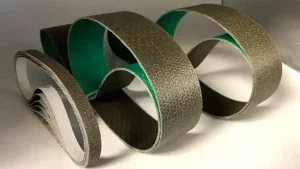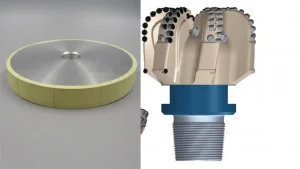
As a typical hard and brittle material, silicon carbide (SIC) ceramics face many technical challenges in its processing. This material has extremely high hardness (Mohs hardness of 9.2-9.3) and excellent thermal stability, but it also shows extremely high thermal sensitivity, which makes it very easy to produce various defects during the grinding process.choose best diamond wheel for grinding SIC is very important.
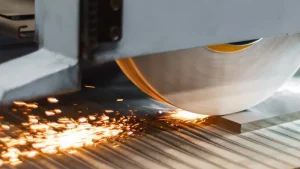
When grinding silicon carbide (SIC)ceramics, although the diamond grinding wheel can provide good surface processing quality, there are significant technical bottlenecks in practical applications. Especially under high-load and large-area grinding conditions, a large amount of grinding heat will be generated in the contact area between the grinding wheel and the workpiece.

Due to the relatively low thermal conductivity of silicon carbide (about 120-150 W/(m·K)), this heat is difficult to conduct and diffuse quickly, resulting in a sharp increase in local temperature. When the temperature exceeds the critical value, it will cause a series of processing defects such as burns, microcracks, and phase changes on the surface of the material, which will seriously affect the mechanical properties and service life of the workpiece.
It is worth noting that other problems that may occur when grinding silicon carbide include:
- Surface/subsurface damage layer formation
- Premature shedding of abrasive particles
- Uneven surface roughness
- Edge chipping
- Residual stress concentration
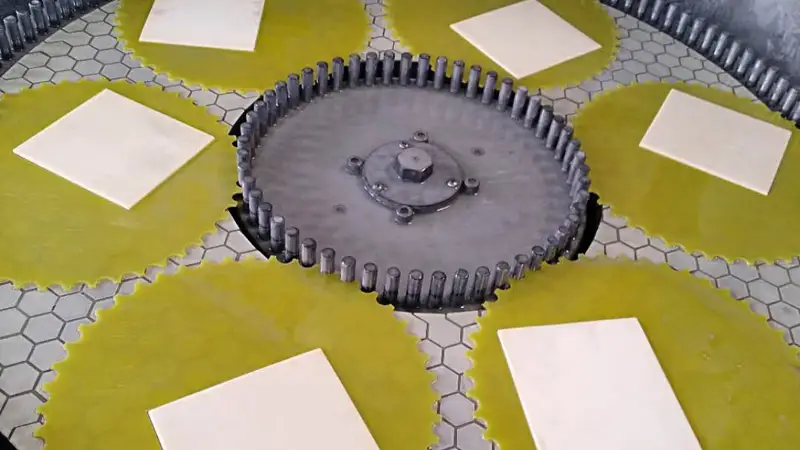
In this paper, we optimize the problem of burning during the grinding process of resin-bonded diamond wheels in the double-end grinding method.
Solutions To Problems In grinding silicon carbide.
To solve these problems, system optimization is required from multiple aspects. First, the selection of binder is crucial. Secondly, the optimization design of the grinding wheel structure cannot be ignored, including the reasonable configuration of parameters such as abrasive concentration, porosity, and abrasive arrangement. In addition, the selection of cooling method, optimization of grinding parameters, and formulation of process route will have a decisive impact on the final processing quality.
Comparison between resin bon and vitrified diamond wheel for grinding SIC
When grinding hard and brittle materials such as silicon carbide, resin bond Diamond wheels have obvious performance limitations. Due to the poor high temperature resistance of the resin material itself, the heat generated during continuous grinding will cause carbonization of the resin matrix. This process will not only cause burns on the grinding wheel surface, but also seriously weaken the holding force of the diamond abrasive grains, causing the abrasive grains to fall off prematurely, significantly reducing the cutting performance and service life of the grinding wheel. As the grinding wheel wears more, the dressing frequency is forced to increase, which not only increases production costs, but also seriously affects processing efficiency.


To improve the performance defects of resin bond diamond wheel for grinding Sic, the following optimization measures can be taken: appropriately reduce the hardness of the grinding wheel to enhance its self-sharpening performance; reasonably adjust the bond ratio to optimize the distribution of abrasive particles; at the same time, improve the chip removal capacity of the grinding wheel and improve the heat dissipation conditions in the grinding area. These adjustments can alleviate the performance degradation of resin bonded grinding wheels under high temperature conditions to a certain extent.
In contrast, Vitrified bond diamond wheel for grinding SiC exhibit better heat resistance and thermal conductivity. Their higher thermal conductivity can more effectively dissipate grinding heat and avoid excessive local temperature rise, thereby significantly improving processing stability. In the processing of hard and brittle materials such as silicon carbide, the efficiency of vitrified bond diamond wheel for SIC is significantly better than that of resin grinding wheels.

Although its final surface finish may be slightly inferior to that of resin grinding wheels, it can fully meet the requirements of conventional processing accuracy for semi-finishing and rough grinding processes. Therefore, vitrified bond grinding wheel for SIC is particularly suitable for customer groups who pursue high-efficiency processing, stability and thermal management performance, and are one of the ideal choices in the field of hard and brittle material grinding.
Improving silicon carbide heat dissipation
During the double-end grinding process, due to the large-area full contact between the workpiece and the grinding wheel and the lack of effective cooling channels, it is difficult for the coolant to fully penetrate the grinding interface. This closed contact form leads to the deterioration of the heat dissipation conditions in the grinding area, and the continuous accumulation of heat, which eventually causes local overheating and even surface burns on the workpiece and other processing defects.
To solve this technical problem, the diamond wheel for grinding SIC structure can be optimized and designed in a targeted manner. By machining a precisely arranged groove structure on the working surface of the diamond grinding wheel, the coolant flow path can be effectively improved. These fine grooves not only provide a stable delivery channel for the coolant, ensuring that the grinding area is continuously and adequately cooled, but also significantly enhance the chip discharge capacity. This dual effect not only reduces the overall temperature of the grinding area, but also reduces the risk of clogging on the surface of the diamond grinding wheel, thereby improving the processing quality and extending the service life of the grinding wheel.
Increase porosity of diamond wheel for grinding SIC
By optimizing the grinding wheel formula structure and appropriately increasing the internal porosity of the grinding wheel while ensuring the abrasive holding strength, the heat dissipation performance during the grinding process can be significantly improved. This special porous structure design can form a through-type microchannel network, which not only greatly improves the thermal conductivity of the grinding wheel body, but more importantly, provides sufficient penetration paths for the coolant, allowing the cooling medium to more fully infiltrate the entire grinding contact area. This dual heat dissipation mechanism can effectively suppress the accumulation of grinding heat and fundamentally reduce the risk of burns on the workpiece surface.

Although increasing the porosity will reduce the overall structural strength of the grinding wheel to a certain extent, resulting in a shortened theoretical service life, it presents many advantages in the actual processing process. First, the continuous and stable heat dissipation performance ensures the balanced control of the grinding temperature and avoids abnormal wear caused by local overheating; second, the good coolant circulation effectively reduces the adhesion and clogging of the abrasive particles, allowing the grinding wheel to maintain a sharp cutting state for a long time; most importantly, this stable grinding condition significantly extends the dressing interval of the grinding wheel, which improves the processing efficiency and reduces the overall production cost.
Practice has shown that this technical solution is particularly suitable for high-load, continuous processing environments. By precisely controlling the ratio of porosity to abrasive concentration, the best balance can be achieved between grinding wheel life and processing stability, providing reliable guarantees for efficient and precise grinding of hard and brittle materials.
If you also encounter similar silicon carbide processing problems, please feel free to contact us to obtain more targeted grinding solutions!