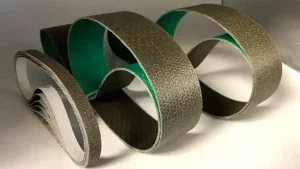
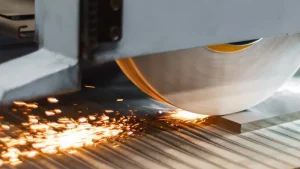
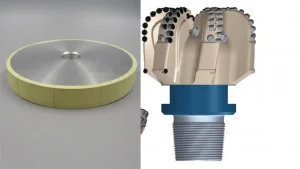
Dry grinding of monocrystalline tools on Coborn grinders is currently the mainstream method for precision grinding of monocrystalline diamond tools.Vitrified diamond wheel for grinding Mcd tools is the first choice .

The main challenges in grinding monocrystalline diamond tools lie in their extreme hardness and brittleness, which can easily lead to edge chipping and cracks during the process. Additionally, the high temperatures generated during grinding can affect tool performance, necessitating effective control. Vitrified diamond wheels demonstrate superior performance in grinding both MCD tools and natural diamond tools, offering better cost-efficiency compared to metal diamond wheels.
Furthermore, to meet the requirements of high-precision applications, strict control over surface quality and shape accuracy is essential. The complex geometries of monocrystalline tools further increase the difficulty of the grinding process, demanding higher overall standards in grinding technology.
What is a Single-Crystal Diamond Tool?
A single-crystal diamond tool is a primary cutting tool in the field of ultra-precision machining. Typically, such tools weigh more than 0.1g, with a minimum diameter and length of no less than 2mm. They can achieve extremely high workpiece accuracy and exceptionally low surface roughness, producing a remarkably smooth finish (capable of mirror-like machining) and are widely recognized as the ideal tool for ultra-precision machining.
Depending on the material source, single-crystal diamond tools are categorized into two types: MCD (monocrystalline Diamond) and ND (Natural Diamond). MCD is a synthetic diamond single crystal, while ND is a natural diamond single crystal.

Due to its extreme hardness and outstanding wear resistance, single-crystal diamond is widely used in optical components, semiconductors, metal processing, and other fields. However, diamond is not “indestructible”—the physical properties of different crystal planes determine its machining performance and service life. Therefore, selecting the appropriate crystal plane is crucial for enhancing tool performance during both manufacturing and application.
Diamond crystals belong to the cubic crystal system, and different crystal planes exhibit anisotropy due to variations in atomic arrangement, atomic density, and interplanar spacing. These differences not only affect the hardness and wear resistance of diamond but also determine its mechanical behavior during cutting.
In common single-crystal diamond machining, the primary crystal planes involved are the {100} plane and the {110} plane.
{100} Crystal Plane:
· Excellent physical stability, resistant to damage;
· Relatively low hardness with average wear resistance;
· Small cutting force, suitable for precision machining, such as high-precision processing in optical components and the semiconductor industry.
{110} Crystal Plane
· High hardness and good wear resistance, but relatively prone to fracture.
· High cutting force, suitable for high-strength and high-efficiency machining, such as in metal processing applications.
Why Do Vitrified Diamond Wheels Exhibit The Following Significant Advantages When Grinding Monocrystalline Diamond Tools?
Extremely High Hardness and Wear Resistance
Material Compatibility: Vitrified diamond grinding wheels use diamond as the abrasive (hardness up to 10,000 HV), which is close to that of monocrystalline diamond (hardness ~9,000–10,000 HV), enabling effective removal of high-hardness materials.
Wear Resistance: The ceramic binder provides strong retention of diamond abrasive grains, preventing premature shedding and ensuring long service life, making it suitable for prolonged high-precision machining.
Superior Machining Accuracy and Surface Quality
Micro-blade Sharpness: Diamond abrasive grains maintain sharp cutting edges, reducing tearing or chipping during grinding and achieving nano-level surface roughness (Ra can reach below 10 nm).
Stability: The ceramic bond offers excellent thermal stability, minimizing deformation at high temperatures and avoiding machining errors. This makes it suitable for the high-precision edge requirements of single-crystal diamond tools (e.g., edge radius < 100 nm).
Efficient Grinding and Controlled Material Removal

High Cutting Efficiency: The high hardness of diamond abrasives and the rigid support of ceramic bonds enable efficient material removal, making it particularly suitable for the challenging machinability of monocrystalline diamond.
Brittle-Ductile Transition: By precisely controlling grinding parameters (e.g., feed rate, cutting depth), monocrystalline diamond can be removed in the ductile mode, reducing subsurface damage.
Thermal Management and Chemical Stability
Heat Dissipation Performance: The vitrified bond exhibits superior thermal conductivity compared to the resin bond, enabling efficient dissipation of grinding heat and preventing graphitization of monocrystalline diamond due to high temperatures (phase transition may occur above 700°C).
Chemical Inertness: vitrified materials do not undergo chemical reactions with diamond, preventing material degradation during the grinding process.
Thermal Management and Chemical Stability
Complex shape processing: vitrified diamond wheels can achieve high-precision profiles through dressing, meeting the complex blade shape requirements (such as arc blades and negative chamfers) of single-crystal diamond tools.
Dry/wet grinding compatibility: It can be used with coolant to reduce thermal effects, and can also be used for dry grinding (parameters need to be controlled to avoid overheating).
Economic advantage
Long life: Compared with metal or resin bonded Diamond wheels, vitrified diamond grinding wheels have a lower wear rate, which reduces the frequency of replacement and is suitable for mass production of single crystal diamond tools.
How Are Such Ultra-precise Monocrystalline Diamond Tools Grinding?
Rough Diamond Wheel for Grinding Mcd Tools
For rough grinding of monocrystalline diamond tools, #800 or #1000 metal diamond wheels or vitrified bond diamond wheel for grinding Mcd tools are typically used. Both types have their advantages:Metal-bonded diamond wheels offer longer lifespan and better shape retention, resulting in higher precision after rough grinding.
Vitrified diamond wheel for grinding Mcd Tools are more economical and cost-effective, with better self-sharpening properties and easier dressing, making them a solid alternative.

In recent years, laser technology has also advanced significantly. Some manufacturers now use lasers for rough grinding (or even cutting), which can improve production efficiency. However, care must be taken to ensure that the laser does not cause blackening or thermal damage at the edges of the monocrystalline diamond.
Laser grinding is another high-precision machining technique capable of handling complex-shaped monocrystalline diamond tools. However, the equipment cost for laser grinding is significantly higher—typically 40%-50% more expensive than mechanical grinding setups.
Fine Diamond Wheel for Grinding Mcd Tools
At the fine grinding stage, metal bonded diamond wheel for grinding Mcd tools or cast iron laps are typically employed.Metal bonded diamond wheels are used with a grit size of #6000 to achieve the required precision.If a cast iron lap is chosen, diamond powder must be applied to the lap to facilitate the grinding process and meet final accuracy requirements.

Some users also opt for vitrified diamond wheels for fine grinding monocrystalline diamond tools. These wheels can achieve an ultra-fine grit size of #10,000, producing a cutting edge sharpness of as low as 3 μm after grinding.
Ultra-Precision Diamond Wheel for Grinding Mcd Tools
The cast iron lap is utilized for the final ultra-precision grinding stage.
Process Details:
Diamond powder with a particle size of 1 μm or smaller is required.
Before grinding, the diamond powder is mixed with oil or a similar medium to form a grinding paste, which is then applied to the surface of the cast iron lap.The paste is left to soak for some time, allowing it to fully penetrate the pores of the cast iron lap.
Pre-grinding is performed to enhance the embedding of diamond particles into the lap’s pores.

Grinding Mechanism:
The hardness and rigidity of the cast iron lap ensure effective contact between the diamond particles and the workpiece surface.
The diamond particles in the grinding paste remove microscopic material through friction and cutting, achieving the desired ultra-precision finish.
Limitations:
Due to the reliance on manual operation, labor costs remain relatively high.
Vitrified diamond grinding wheels are suitable for precision edge sharpening, offering high sharpness and effectively reducing edge chipping.Metal diamond grinding wheels provide better profile retention, longer service life, and a higher price point.
During the actual grinding process, fine-grit diamond wheels may fail to meet the required workpiece specifications when grinding MCD tools. This issue primarily stems from two causes:Excessive edge chipping during rough grinding, making it impossible for fine grinding to fully eliminate previous scratches.Contamination of the fine-grinding wheel by large diamond particles or foreign debris, leading to scratches on the MCD workpiece.
NewDiamondTool offers diamond wheel for grinding MCD tools with superior stability, ensuring high-quality rough-ground edges. This helps reduce fine-grinding time and costs while improving finishing efficiency.