How to improve the defects during alumina processing by vitrified bond diamond grinding wheel?
The defects in the grinding process of alumina can be avoided by using vitrified diamond wheel for alumina, thereby improving the surface quality of alumina workpieces and enhancing grinding efficiency.
About Alumina and Grinding Technology
Alumina ceramic material has excellent performance such as high elastic modulus, wear resistance, chemical corrosion resistance, and goog high-temperature stability. It is widely used in the fields of electronics and machinery.

However, alumina is a brittle material with high hardness and brittleness. Its physical and mechanical performance( especially toughness and strength) is significantly different from metal materials, and the processing performance is poor, making it difficult to process. Due to 12%-25% shrinkage of firing line and some firing deformation during high-temperature sintering of alumina ceramic, the size and surface roughness of the initially fired ceramic often do not meet the corresponding precision requirements.
How to efficiently process the fired ceramic blanks into ceramic parts with dimensional accuracy and surface roughness that meet the standards is a problem when processing alumina.


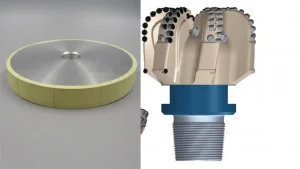
Due to the high hardness of alumina ceramic, corundum or silicon carbide grinding wheels cannot grind it. Therefore, diamond grinding wheel can be used for grinding and processing, and the dimensional accuracy of the processed ceramic parts is suitable. There are resin bond, vitrified bond, metal bond, and electroplated bond available. It is concluded that vitrified bond diamond grinding wheel is an ideal superhard tools for grinding alumina by comparing the performance of different bond. Various defects in the grinding process can be avoided by the application of vitrified diamond wheel for alumina.
Defects During Alumina Grinding Process
---1.Defects of ceramic parts edges and corners
In terms of the performance of ceramic materials, alumina ceramics have high mechanical strength, but the toughness is poor. In ceramic grinding, the edges and corners of the ceramic parts have defects, which not only affect the appearance quality of ceramic products, but also the edges and corners can easily scratch hands and have safety hazards.
---2.Poor surface roughness
The requirements of dimensional accuracy and surface roughness of ceramic parts are high. During rough and fine grinding processes, there are many factors related to the design of grinding wheels. The speed of diamond grinding wheel is low, and the feed rate is too fast, and the one-time feed amount is too large, and the final feed grinding time is too short.

The grain size of the diamond grinding wheel is too coarse, and the rough grinding scratches are too large, making it difficult to eliminate the scratches. The bonding agent of diamond grinding wheel is set too hard, resulting in poor self sharpening of grinding wheel, and diamond particles cannot be exposed timely, leading to poor sharpness. Diamond powder itself has low quality and poor sharpness. The fine grinding is too short, and the rough scratches have not completely been eliminated.
The fine grinding is too short, and the rough scratches have not completely been eliminated.
----3.Alumina ceramic parts with rough working surface
The main reason for the appearance of tough marks on the surface of ceramic parts is the friction between the parts and the grinding wheels due to the coarse diamond particles or ceramic debris. The marks left by rough grinding have been not completely eliminated by fine grinding. The bond of grinding wheel is too soft and the diamond particles easily fall off.
----4.Wavy marks on the surface of ceramic parts
Take a cross-section of the finished ceramic parts and enlarge it, it can be seen that the surface is approximately wavy. The reason for the wavy surface is that the movement of the grinding wheel or the periodic variation of the grinding pressure on the parts, which can be forced variation or self-excited vibration. Therefore, there are often more than one types of vibration on ceramic parts. Too high hardness of the bonding agent of the diamond grinding wheel results in slow self sharpening.
----5.Fish scale on ceramic surface
Metal bond diamond grinding wheel has good rigidity and good bonding between diamond and bonding agents, but they also bring a problem of frequent block during the grinding process, requiring frequent dressing of the wheels. For example, the following is a kind of grinding process: electrolytic grinding of diamond grinding wheel.
There are many causes that affect the defects in alumina ceramics, including the ceramic parts, grinding machine, grinding conditions, working environment and the operators. This paper only analyzes the problems of diamond grinding wheels we are most familiar with. Vitrified diamond wheel for alumina ceramic have good self sharpening, good rigidity, high grinding efficiency, high strength, good surface retention, not easily deformed, and almost no dressing.In addition to the vitrified diamond wheel for alumina formula, vitrified diamond wheel for zirconium are also widely used.
With many years of researching Vitrified diamond wheel for alumina ceramic , we have scientific formula technology, high quality diamond abrasives, fully automated mixing and sintering process, and it avoids the problems such as low sharpness of diamond particles, uneven mixing, and uneven sintering hardness. Many grinding problems can be avoided in the process of alumina ceramics grinding.