When grinding stainless steel, corundum grinding wheels are generally selected. If high grinding accuracy is required, CBN grinding wheel for Stainless steel is selected.
Stainless steel is a typical difficult-to-process material, known for its high toughness, low thermal conductivity and small elastic modulus. These characteristics bring multiple challenges during the grinding process:
- Grinding wheel adhesion and clogging – grinding chips are easy to adhere, resulting in reduced cutting efficiency;
- Surface burn risk – poor thermal conductivity causes local high temperature, affecting the integrity of the workpiece;
- Work hardening is prominent – material deformation resistance is increased, and accuracy is difficult to control;
- Workpiece deformation tendency – low elastic modulus amplifies the deformation caused by processing stress
Stainless Steel Types
There are many types of stainless steel.According to the composition, it can be divided into chromium stainless steel, chromium-nickel stainless steel, etc.

According to the internal structure, it can be divided into martensitic stainless steel, ferritic stainless steel, austenitic stainless steel, austenitic-ferritic stainless steel, precipitation hardening stainless steel, etc.
3 Difficulties In Grinding Stainless Steel
3.1 1. Process Characteristics Of Stainless Steel Grinding
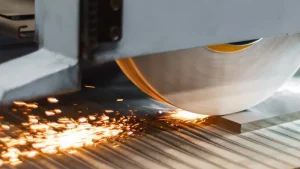
Stainless steel has high strength, high toughness and high temperature resistance. It will produce significant lattice distortion and plastic deformation during grinding. Its cutting force per unit area is as high as 90GPa, which is 1.5-2.2 times that of 45# steel. At the same time, since the thermal conductivity is only 1/3 of that of 45# steel, the grinding area is prone to instantaneous high temperatures of 1000-1500℃, resulting in burns, cracks and even annealing layers with a depth of 0.01-0.02mm on the surface of the workpiece.

3.12 Significant Work Hardening Phenomenon
During the grinding process, the workpiece surface deforms violently, and the stress and strain increase to form a hardened layer. The grain distortion in the hardened layer accelerates the passivation of the sand grains, which in turn causes surface defects such as vibration marks and scratches.
3.2 Main Forms Of Grinding Wheel Failure
Grinding chip adhesion and grinding wheel clogging: The high toughness of stainless steel makes grinding chips easy to react with abrasive grains under specific temperature, pressure and speed conditions. The order of adhesion is: concentrated nitric acid resistant stainless steel > heat resistant stainless steel > 1Cr18Ni9Ti > 1Cr13/2Cr13.

Grinding chips filling the gap between abrasive grains will lead to deterioration of cutting conditions and a sudden drop in surface roughness. Abrasive grains are rapidly passivated. Typical grinding ratio comparison: stainless steel: G=6-12, carbon steel/low alloy steel: G=40-80, stainless steel grinding efficiency is only 1/7 of ordinary steel
3.3 Common Processing Defects And Causes
Surface burns: Austenitic stainless steel is particularly sensitive to burns
Surface scratches: The main causes include: scratches by protruding abrasive particles on the grinding wheel surface; secondary scratches by falling grinding chips; contamination or insufficient supply of grinding fluid

Workpiece deformation: Dual influencing factors – large linear expansion coefficient leads to temperature sensitivity; severe work hardening produces residual stress
*Note: Low-rigidity workpieces such as slender shafts and thin-walled parts have a higher risk of deformation
4 How To Choose The Right Grinding Wheel For Stainless Steel
4.1 Which abrasive is chosen to grind stainless steel?
4.1.1. Conventional Choice: White corundum (WA) grinding wheel for stainless steel
Advantages: Good cutting performance, strong self-sharpening, economical price.
Applicable scenarios: General stainless steel grinding needs, high cost performance.

4.12. Best Choice: Cubic Boron Nitride (CBN) grinding wheel for stainless steel
Recommended parameters: grain size F120, concentration 100%, resin bond.
Advantages:
High hardness: abrasive grains are wear-resistant and have a long service life.
Chemical stability: does not react with iron group elements to avoid carburization problems.
Anti-clogging: can maintain stable cutting performance during high temperature grinding.
Low grinding force & low thermal impact: reduce the risk of workpiece burns.

Notes:
The price is higher than ordinary grinding wheels, and reasonable dressing is required to optimize costs.
4.1.3. Single crystal corundum grinding wheel for stainless steel
Features: The abrasive grains are spherical polyhedral single crystals, without mechanical crushing cracks, and low residual stress. Excellent hardness and toughness matching, stable grinding performance.

Application advantages: Acid-resistant stainless steel: Reduce grinding scratches, especially suitable for large-diameter processing, and the grinding effect is second only to CBN grinding wheels.
4.14. Microcrystalline corundum grinding wheel for stainless steel
Cr17Ni7A1 precipitation hardened stainless steel: Recommended grinding wheel: microcrystalline corundum (MA).
Advantages: high toughness, good cutting performance, long life; self-sharpening is achieved through microcrystalline cracking, avoiding large particles from falling off, reducing grinding heat and clogging risks.

Austenitic stainless steel: Recommended grinding wheel: microcrystalline corundum + green silicon carbide composite grinding wheel.
Effect: significantly reduce the roughness of the workpiece and reduce or eliminate the burning phenomenon
4.1.5 Why not choose diamond grinding wheel for stainless steel
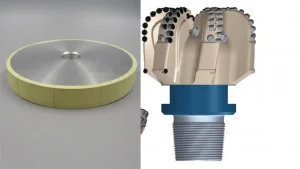
Don’t use diamond grinding whee for stainless steel. Although diamond grinding wheel can grind beautiful surface on HSS, diamond is pure carbon and can be carbonized under high temperature. If you really want to use diamond grinding wheel for grinding, it should be under extremely harsh conditions, such as grinding for a short time, and ensure that the heat can be dissipated quickly.
Using CBN grinding wheel, its service life in HSS is about 20 times that of diamond. On the Internet, there is diamond grinding wheel for hss. I have seen people search for this, but this is against scientific principles.
4.1. 6 When to use CDX grinding wheel.

As mentioned above, diamond grinding wheel is not suitable for grinding stainless steel, and CBN is also not suitable for grinding carbide (related reading:how to choose grinding wheel for tungsten carbide). So what should we do when the workpiece contains both stainless steel and carbide?
We have CDX grinding wheel , C for CBN, D for Diamond, and X to signify the mixture. We produce it and have applied it in actual production. As for the ratio of C and D, it will be determined according to the actual situation of the workpiece.
4.2.What grit grinding wheel for stainless steel
The abrasive grain size has a direct impact on the surface roughness. Stainless steel has high toughness and is easily clogged by grinding chips. If a fine-grained grinding wheel is used, the abrasive loses its cutting effect and the surface finish of the workpiece is not high. The results show that F36 and F46 grits are used for rough grinding, and F60 grits are used for fine grinding. F46 and F60 grit grinding wheels are used for both rough and fine grinding.
4.3 Selection of binder grinding wheel for stainless steel
Stainless steel has the characteristics of high toughness, high temperature resistance, high strength, and high grinding force, so the grinding wheel is required to have high strength and be able to withstand large impact loads.

When grinding stainless steel, whether it is a corundum-based ceramic bond grinding wheel, it has good waterproof, heat-resistant, and corrosion-resistant properties, can maintain good cutting performance, and has high production efficiency. The disadvantage is that it is brittle and cannot withstand large impacts and bending.
Commonly used binders for BN grinding wheels include resin binders, vitrified binders, and electroplated grinding wheels. Resin binders are highly sharp and economical, and can grind out good end faces. Vitrified binders have good rigidity and self-sharpening properties, as well as a long lifespan, but are slightly more expensive. Electroplated CBN grinding wheels can be made into very high and multi-shaped grinding wheels with arcs. For example, electroplated CBN grinding wheels are widely used for grinding stainless steel band saws.


In the scene of cutting stainless steel workpieces, resin bond cutting wheels (divided into ordinary abrasives and CBN cut off wheels ) are used for cutting, grooving, and centerless grinding of stainless steel. They have high strength, good elasticity, impact resistance, and many pores, and can be used for higher peripheral speeds (35-75m/s). However, resin bond grinding wheels have low hardness and are not resistant to high temperatures. When the temperature is higher than 150°C, the resin bond will soften, reduce strength, and even burn, so they should be cooled during grinding.
4.4 Selection of grinding wheel hardness
When grinding stainless steel, you should use a grinding wheel with lower hardness and better self-sharpening. If the hardness is too low, the abrasive grains will not be firmly bonded and will fall off before being blunted, which will greatly reduce the service life of the stainless steel grinding wheel.
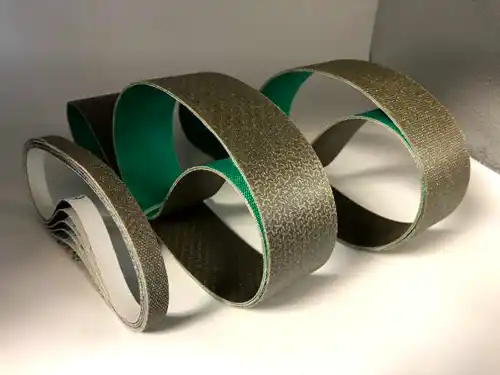
In short, when grinding stainless steel, CBN grinding wheel and ordinary grinding wheel should be selected according to the economic situation and the actual situation of the grinding material. In addition, ordinary abrasive belts, diamond abrasive belts, CBN abrasive belts, and diamond flap wheels are also used for grinding in practical applications.