How to sharpen circular saw blade?It is necessary to select the appropriate grinding wheel (diamond or CBN) with a resin bond, and sharpen the tooth’s rake angle, clearance angle, and side edges to ensure the blade achieves excellent sharpness.
Regarding Sharpen Circular Saw blade
2.1 Sharpen Circular Saw Blades Before Leaving the Factory
Before leaving the factory, the saw blade needs to have its teeth sharpened to ensure sharpness, meet factory standards, and satisfy customer requirements.
2.2 After using the circular saw blade for a period of time
After being used for some time, the circular saw blade teeth wear out and become dull, increasing cutting resistance. Re-sharpening can recondition the cutting edge and improve cutting efficiency. Sharpening can restore the blade’s cutting accuracy and ensure cutting quality. Typically, a circular saw blade can be re-sharpened 3-10 times (depending on wear), making it more economical than direct replacement.
3 Selection of Grinding Wheels for Sharpen Circular Saw Blade
3.1 Circular saw blades are generally categorized into carbide-tipped saw blades and high-speed steel saw blades.
Carbide-tipped saw blades: Due to their high hardness and wear resistance, they perform exceptionally well in cutting applications, delivering smooth cuts with minimal deformation. They are particularly suitable for cutting materials such as wood planks, aluminum sheets, aluminum rods, copper pipes, and copper bars.
Carbide-tipped saw blades
HSS Saw Blades
High-speed steel (HSS)saw blades: These are relatively more affordable and suitable for general cutting needs. Although they lack the hardness and wear resistance of carbide-tipped blades, they remain a cost-effective choice when budgets are limited or cutting demands are less frequent.
The number of carbide saw blades is greater than that of HSS saw blades.
3.2 Selecting Grinding Wheels Based on the Workpiece
For grinding carbide saw blades, choose diamond grinding wheels. For grinding HSS saw blades, select CBN grinding wheels.
Diamond Grinding Wheels
CBN Grinding Wheels
Regarding bonding agents, resin-bonded wheels are the preferred choice. Whether it’s a resin bonde diamond wheelor a resin bonde CBN wheel, both offer the following advantages: high grinding efficiency, excellent self-sharpening properties, low heat generation, resistance to clogging, and good elasticity.
4 How to Sharpen Circular Saw Blade Process
4.1 Sharpening of the front angle (tooth surface) of carbide circular saw blade
1. Tooth surface (serrated end face) 2. Tooth surface with negative rake angle 3. Concave tooth surface (concave surface)
Concave grinding is also a type of tooth sharpening, which is carried out at high speed using a grinding head. However, this method cannot be applied to every circular saw blade. Special attention should be paid to concave grinding: In order to be able to grind the tooth surface during peripheral grinding, a certain chip groove must be left, and in particular, it should be ensured that the grinding head is positioned precisely at the center of the carbide saw blade thickness and cutting width.
Sharpening the tooth surface using end face grinding
Front angle grinding wheel shape: 4A2, 12V2, 12V9,
It can be selected according to the tooth pitch size Abrasive: Diamond Bond: Resin Workpiece material: Carbide teeth
4A2 Front angle grinding wheel
12V2 Front angle grinding wheel
12V9 Front angle grinding wheel
4.2 Grinding of the tooth top (back angle) of carbide circular saw blades
Compared with tooth surface grinding, the grinding of the tooth top of circular saw blades is more diverse.
1. Tooth top on carbide saw blade (back of saw tooth) 2. Tooth top of HW tooth (back of saw tooth)
Due to the different tooth flank geometries, from straight to almost circular, tooth tip grinding is mainly carried out as end face grinding or peripheral grinding.
Different tooth shapes in tooth tip grinding
1. Flat 2. Slanted on the right side 3. Slanted on the left side4. Slanted on both sides alternately
1. Tooth top machining in face grinding 2. Tooth top machining in peripheral grinding
Among them, the end face grinding method is particularly time-saving. When processing different tooth shapes (such as trapezoidal, V-shaped, etc.), the grinding wheel only needs to rotate a certain angle.
Back angle grinding wheel Grinding wheel shape: 12A2, 6A2
Processing material: carbide teeth
Processing object: saw blade Back angle
Grinding wheel characteristics: Grinding wheel has good sharpness and high grinding efficiency; the workpiece has good flatness; the grinding wheel has good durability and long life; the grinding wheel can perform rough machining and fine machining at the same time, and the surface finish of the workpiece is good.
6A2 Diamond Wheel for Sharpen Circular Saw Blade
12A2 Diamond Wheel for Sharpen Circular Saw Blade
4.3 Tooth side grinding of carbide circular saw blades
The accuracy of the saw tooth side has a critical impact on the surface quality. Therefore, when grinding the tooth side of a circular saw blade, in order to avoid the blade from pressing into the material, the saw tooth side is sharpened along the cutting and feeding direction. The end face grinding method or the peripheral grinding method is required for one-time grinding.
1. Tooth side facing downward, along the feed direction, becoming sharper 2. Tooth surface 3. Tooth side facing backward, along the feed direction, becoming sharper 4. Tooth surface
1. Side grinding in face grinding 2. Side grinding in peripheral grinding
Side grinding wheel Grinding wheel shape: 1A1, 3A1, 14A1
Processing material: Carbide teeth
Processing object: Saw blade side angle
Grinding wheel characteristics: Good grinding wheel sharpness, high grinding efficiency, good grinding wheel durability and long life.
5 Diamond Grinding Wheel Grit Selection for Circular Saw Blades
In the actual sharpen circular saw blades, the selection of diamond grinding wheel grit size directly affects the quality of the blade’s cutting edge. The edge quality in turn determines the cutting performance of the saw blade, making grit size selection critically important. Below is a series of magnified tooth photos illustrating the importance of proper grit selection: An ideal magnified tooth profile (as shown below) is achieved using a grinding wheel with 280/600 grit size:
Perfect Effect of Circular Saw Blade Picture
In actual saw blade applications, when the tooth tip is worn to a certain extent, the saw blade will not be sharp and needs to be sharpened. The enlarged photo of the teeth of an aluminum saw blade to be sharpened is as follows:
A Cutting Aluminum Saw Blade Need to Sharpen
An enlarged photo of the teeth of a wood-cutting saw blade waiting to be sharpened is as follows:
Saw Blade Need to Sharpen For Cutting Wood
By observing the wear width of the saw tooth tip in the above two pictures, when the wear width of the aluminum cutting saw blade tip is 0.089mm, the customer reported that there are burrs when cutting aluminum profiles, and it needs to be sharpened. When the wear width of the wood cutting saw blade tip is 0.247mm, the customer reported that the saw blade is blunt and needs to be sharpened. Therefore, the initial edge integrity of the tip is crucial to the life of the saw blade, and the integrity of the saw blade tip depends on the cutter head material, equipment status, and diamond grinding wheel grit.
Below are the enlarged photos of the saw teeth processed by the rear angle grinding wheels 240# and 400#:
Saw Blade Back Angle Sharpening By Diamond Wheel 240#Vs400#
The above photos clearly show that the saw teeth processed by the 400# grinding wheel have better integrity than those processed by the 240# grinding wheel;
In addition, we should also pay attention to the influence of the diamond grinding wheel rotation direction on the integrity of the saw teeth. The following are enlarged photos of the front angle after grinding with front angle grinding wheels of different grits:
Sharpen Circular Saw Blade Front Angle By 320# Diamond Wheel
Sharpen Circular Saw Blade Front Angle By 600# Diamond Wheel
The above photos show that the cutting edges of the 600# front angle grinding wheel and the 320# front angle grinding wheel are intact in the direction of the grinding wheel entering, but the cutting edge integrity of the 600# is much better than that of the 320# in the direction of the grinding wheel exiting;
The above photos show that the cutting edge of the 600# front angle grinding wheel and the 320# front angle grinding wheel are both intact in the direction of the grinding wheel entering, but the cutting edge integrity of the 600# front angle grinding wheel is much better than that of the 320# front angle grinding wheel in the direction of the grinding wheel exiting.
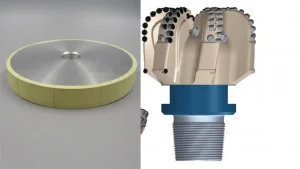
By selecting the appropriate diamond grinding wheel and CBN grinding wheel, selecting the appropriate force according to different grinding scenarios, and cooperating with strict grinding process, the saw teeth after sharpening can have good sharpness. Our Newdiamondtools company produces diamond wheel for sharpening carbide saw blade and CBN wheel for sharpening Hss saw blade. We have rich experience and can provide grinding wheels of different sizes and models for testing. For example, the following drawing is a common superabrasive grinding wheel for woodworking tools.