In order to choose the right grinding wheel for titanium alloy,Dry grinding experiments on titanium alloy were carried out on resin CBN grinding wheel and SiC grinding wheel respectively, and the surface morphology, roughness and grinding force of titanium alloy were studied under the same parameters.
The results show that with the increase of grinding depth, the surface morphology of titanium alloy after grinding by SiC grinding wheel gradually deteriorates, the material accumulation increases, and the surface roughness is seriously affected; under the same experimental conditions, the surface quality of titanium alloy with CBN grinding wheel is significantly better than the former, mainly because the CBN grinding wheel generates less grinding force, less extrusion on the workpiece, and less heat during processing.


This paper analyzes and studies the grinding wheel for titanium alloy with resin CBN wheel&SIC wheel to explore a new way to improve the grind ability of titanium alloy.
Cutting Experiment Of Grinding Wheel For Titanium Alloy
The grinding experiment in this study was completed on a MGK7120×6 surface grinding machine. The experiment used TC4 titanium alloy as the workpiece material, and its specific parameters were: size 20mm×20mm×5mm, density 4.5g/cm³, hardness 30HRC, yield strength 860MPa, and tensile strength 950MPa. The workpiece was fixed and mechanically measured using a Kistler9257BA dynamometer.

Two types of grinding wheels were selected for comparative study: phenolic resin bonded CBN grinding wheel and green silicon carbide grinding wheel. Both grinding wheels adopt 1A1 standard, and the specific specifications include: 80 mesh, outer diameter φ150mm, inner diameter φ32mm, and thickness 20mm. To ensure the accuracy of the experimental data, the surface of the diamond grinding wheel was polished with 600# before the formal experiment, and the surface roughness Ra value reached 0.2μm after treatment.

The experimental processing parameters are detailed in Table 1, and the schematic diagram of the experimental device is shown in Figure 1. By comparing the processing performance of the two grinding wheel for titanium alloy, an experimental basis is provided for titanium alloy grinding.
Experimental Results And Analysis
2.1 Surface Morphology Analysis
Under the condition of feed speed vw=20mm/s, this study investigated the effect of different grinding depths on the surface morphology of the workpiece. Figure 2 shows the grinding surface features under different parameters:
(1) When the grinding depth ap=5μm (Figure 2a), the workpiece surface mainly shows the plastic deformation characteristics formed by abrasive extrusion, and a large number of continuous plastic grooves and scratches can be observed.
(2) As the grinding depth increases (Figure 2b), the surface morphology changes significantly:
The material accumulation phenomenon is significantly intensified

- Irregular material flow perpendicular to the machining direction occurs
- The surface roughness increases significantly
- The changes in these morphological features reflect the changes in the material removal mechanism
during the grinding process as the cutting depth changes.
The surface morphology of titanium alloy ground by CBN grinding wheel is shown in Figure 3. By comparing Figures 2 and 3, it can be observed that although the surface quality of CBN grinding wheel will decrease when the grinding depth increases, its processing quality is still significantly better than that of SiC grinding wheel.
This phenomenon is mainly due to the difference in heat dissipation mechanism during dry grinding: under dry grinding conditions, heat dissipation is mainly achieved through grinding wheel, chips and workpiece, and because the amount of chips generated by grinding is small, the heat carried away by chips is limited, so the heat transfer characteristics of the grinding wheel become the key factor affecting the grinding temperature.

Compared with SiC grinding wheel for titanium alloy , CBN grinding wheel has better thermal conductivity, and its efficient heat transfer efficiency enables the heat generated in the grinding area to diffuse quickly through the grinding wheel itself. This characteristic not only significantly reduces the temperature of the grinding area, but also effectively reduces the hot melt adhesion of the grinding wheel, so that the CBN grinding wheel abrasive can maintain a sharper cutting state and reduce the extrusion effect on the workpiece,
2.2roughnes Of Grinding Wheel For Titanium Alloy
The surface roughness characteristics formed by grinding are mainly due to the microscopic cutting marks left by a large number of abrasive grains on the surface of the grinding wheel on the workpiece surface. These abrasive grains will form densely arranged micro grooves during the processing. Due to the unidirectionality of the grinding motion, the surface roughness perpendicular to the grinding direction is significantly higher than the roughness along the grinding direction. Therefore, this experiment focuses on measuring the roughness parameters perpendicular to the grinding direction.
Table 2 shows the surface roughness test results of titanium alloy specimens under different grinding parameters. The experimental data show that with the increase of grinding depth, the surface roughness of titanium alloy shows a significant upward trend. This phenomenon is particularly evident when using SiC grinding wheels for processing, and the increase in roughness is more prominent than that under other processing conditions.
When analyzing the grinding surface roughness from a geometric perspective, the depth of the abrasive penetrating into the material surface is one of the decisive factors. Studies have shown that the abrasive penetrating depth is positively correlated with the surface roughness, that is, the shallower the penetrating depth, the smaller the surface roughness value obtained. As the grinding depth increases, the abrasive penetrating depth and the furrow depth formed increase accordingly, which directly leads to a significant increase in surface roughness.

Compared with traditional cutting processes, grinding has three significant characteristics: extremely high grinding speeds, large grinding ratios, and abrasive particles generally presenting a negative rake angle geometry. These characteristics, coupled with the high temperature effect in the grinding zone, can easily cause thermal melting deformation of the workpiece surface, and even grinding burns in extreme cases.
Therefore, the degree of plastic deformation during grinding far exceeds that of turning or milling. Especially in titanium alloy processing, the synergistic effect of grinding force and grinding heat can cause lateral tensile deformation of the surface metal lattice, resulting in defects such as microcracks and local metal accumulation.
It is worth noting that the factors that affect the plastic deformation of the grinding surface are often also the key parameters that determine the surface roughness. Experimental data show that under the condition of 5μm grinding depth, the grinding heat generated by both grinding wheels is less, the degree of plastic deformation of the workpiece is slight, and the measured surface roughness values are similar.
when the grinding depth increases to 20μm, due to the poor thermal conductivity of the SiC grinding wheel, the heat accumulation in the grinding area causes the temperature to rise, the thermoplastic deformation of the workpiece intensifies, and the surface roughness Ra value rises to 0.75μm.
2.3Grinding Force Of Grinding Wheel For Titanium Alloy
In the research of grinding force, the test data of CBN grinding wheel and SiC grinding wheel (Figure 4, Figure 5) show that the grinding force is linearly positively correlated with the grinding depth. The mechanism analysis shows that increasing the grinding depth will increase the cutting depth of a single abrasive grain, the contact arc length between the grinding wheel and the workpiece, and the number of effective grinding edges. The combined effect of these three factors leads to a significant increase in the grinding force. This law shows a stable corresponding relationship under different grinding parameter conditions.


Comparing the experimental data of Figure 4 and Figure 5, it can be seen that the CBN grinding wheel shows significant performance advantages in the grinding process. Specifically, on the one hand, its grinding force value is significantly lower than that of the traditional SiC grinding wheel; on the other hand, the ratio of the grinding normal force to the tangential force also shows a downward trend.
This difference is mainly due to the different characteristics of the two grinding wheel materials: SiC grinding wheels are prone to abrasive adhesion and passivation under high-temperature grinding conditions, resulting in continuous attenuation of cutting performance; while CBN grinding wheels, with their unique self-sharpening characteristics, can continuously keep the abrasives sharp, thereby achieving more efficient material removal and more stable processing performance.
3 Conclusions of Grinding Wheel For Titanium Alloy
This study has drawn the following important conclusions through systematic comparative experiments:
(1) Surface quality: The surface integrity of the workpiece processed by CBN grinding wheel is significantly better than that of silicon carbide grinding wheel, which is manifested in that the number of surface defects such as macro cracks is reduced by about 40%, and the degree of surface damage is reduced by more than 35%;
(2) Roughness performance: When the grinding depth increases to 50μm, the surface roughness Ra value of CBN grinding wheel is improved by 30%-45% compared with that of silicon carbide grinding wheel, and the advantage is more obvious with the increase of grinding parameters;
(3) Grinding force characteristics: Under the working conditions of feed speed of 20mm/s and cutting depth of 20μm, the tangential force and normal force of CBN wheel are reduced by 25.3% and 48.9% respectively, and the maximum grinding force difference can reach 120N. These findings provide important experimental basis for the selection of tools for high-precision grinding.


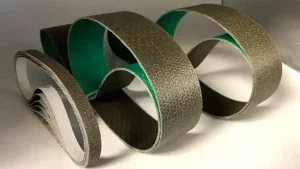
(4) Due to cost issues, this test uses ordinary resin CBN grinding wheels. In fact, Vitrified CBN grinding wheels have better effects in the rough grinding process than resin bonded wheels, because they not only have good self-sharpening properties, but also have better rigidity than resin bonded grinding wheels. Their service life is 2-3 times that of resin bonded wheels. When grinding irregular titanium alloy workpieces, there are also diamond belts, diamond flap wheels, and diamond flap wheels to choose from.
Related Reading: +100% Efficiency, Select CBN Wheel for Titanium Alloy! 2025