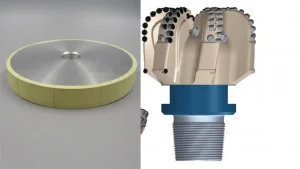
When grinding titanium alloy with grinding wheels, Vitrified CBN (Cubic Boron Nitride) wheels offer better grinding quality and longer service life compared to SIC grinding wheels.CBN wheel for titanium alloy is first chooc
During the grinding process of titanium alloy, the grinding force is high, resulting in elevated grinding temperatures. The wheel wears out quickly, leading to low production efficiency. Additionally, the wheel dulls rapidly, making it difficult to ensure consistent surface quality and further reducing grinding productivity. Adhesion significantly impacts grinding forces. Moreover, titanium alloy materials also suffer from severe wear under prolonged, high-intensity use, and poor wear resistance is one of their major drawbacks. Therefore, selecting the appropriate grinding wheel is essential
About Titanium Alloy
Titanium alloy is a high-strength, corrosion-resistant metal material widely used in aerospace, medical equipment and automotive industries. However, due to its material properties, such as low thermal conductivity, high chemical activity and high affinity with tool materials, titanium alloy is difficult to process in grinding, and good grinding wheels are particularly important.
Main Problems In Titanium Alloy Grinding
High Grinding Temperature
Titanium alloys possess high strength and excellent thermal resistance, which leads to the generation of significant heat during the grinding process. However, their thermal conductivity is even lower than that of nickel-based superalloys. During grinding, apart from a portion of the heat being dissipated through grinding chips, cutting fluid, and the grinding tool, only a small fraction of the remaining heat is conducted into the workpiece in a timely manner. This results in a substantial accumulation of grinding heat in the contact zone.

On one hand, this accelerates tool wear; on the other hand, it thickens the heat-affected layer on the workpiece surface, degrading the mechanical properties of the part. In some cases, processing efficiency must be reduced to mitigate the adverse effects of heat accumulation.
The high-temperature environment also accelerates chemical reactions, exacerbating the adhesion of abrasive grains. This not only speeds up wheel wear but also significantly deteriorates the surface quality of the machined workpiece.
Large Elastic Deformation Of Workpiece Material
The elastic modulus of titanium alloy is relatively low, resulting in significant elastic deformation during its grinding process, which restricts machining accuracy—especially for thin-walled components. This also leads to a rise in temperature in the grinding zone. Additionally, the elastic deformation and recovery of the workpiece material are major contributors to cutting vibrations. Greater elastic deformation in the workpiece material increases the contact area between the workpiece and abrasive grains, exacerbating flank wear on the abrasive grains.

Serious Tool Adhesion
Titanium alloys exhibit good plasticity, making them prone to the “cold welding” phenomenon under the contact pressure between the cutting edge and the workpiece material, leading to material adhesion. Additionally, due to their high chemical reactivity, titanium elements can easily undergo chemical reactions with carbon, nitrogen, and other elements in the tool material, as well as oxygen in the air under grinding temperatures, further intensifying the tendency for adhesion between the tool and workpiece materials. When adhered workpiece material detaches, it may cause a small amount of abrasive material to break away as well. Severe adhesion is one of the primary reasons for rapid tool wear during the grinding of titanium alloys.

Grinding Properties Of Titanium Alloys
High grinding temperature and high grinding force are the notable characteristics of titanium alloy grinding. Under normal grinding conditions, the grinding force corresponding to Ti-6Al-4V is about 1.5 to 2 times that of 45 steel, and the grinding temperature is about 20% to 30% higher.
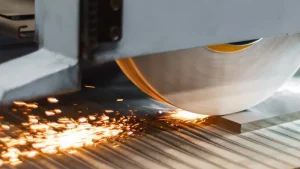
Even if a CBN wheel for titanium alloy with good thermal conductivity is used, the grinding temperature is as high as 400°C. If the slow-feed deep cutting process is used to grind titanium alloy, it is difficult for the cutting fluid to fully cool the entire grinding arc area, and special attention should be paid to grinding temperature control. Unlike cutting, grinding relies on the micro-cutting action of many grinding edges to remove materials, and it is a negative rake angle cutting.

Therefore, the workpiece material is deformed more violently under the extrusion and cutting of the abrasive particles, resulting in the grinding surface often having a more serious fish-scale coating and other phenomena. Increasing the grinding speed can significantly improve this problem by reducing the thickness of a single abrasive particle.
Under normal grinding conditions, due to the high grinding temperature, the surface of the workpiece after grinding is mostly residual tensile stress. For example, when Ti-6Al-4V is machined with a SiC grinding wheel under normal grinding conditions, the residual tensile stress on the grinding surface is as high as 500MPa or more. If a slow-feed deep-cut grinding process is used, the arc zone temperature is only about 100°C during normal grinding. At this time, the grinding force plays a leading role in the formation of residual stress, so the surface is mostly residual compressive stress.
SIC Grinding Wheel VS CBN Grinding Wheel For Titanium alloy
After Multiple Grinding Comparisons:


The Vitrified CBN grinding wheel provides better surface quality than the SiC wheel, with improved surface integrity, fewer macroscopic cracks, and less surface damage. The CBN wheel also achieves superior surface roughness compared to the SiC wheel, and the difference becomes more pronounced as the grinding depth increases. Additionally, the vitified CBN wheel for titanium alloy generates lower tangential and normal forces than the SiC wheel.

The CBN wheel for titanium alloy exhibits excellent thermal conductivity, allowing efficient heat dissipation. During grinding, the heat generated in the grinding zone is quickly diffused, leading to a faster temperature drop. This reduces thermal adhesion on the wheel, helping the CBN abrasive grains maintain sharpness and minimizing workpiece deformation. In contrast, the SiC wheel suffers from severe adhesion, leading to rapid dulling and weakened grinding performance.

Furthermore, the vitrified bond offers a self-sharpening effect, ensuring that worn abrasive grains shed promptly, exposing fresh diamond particles. This mechanism allows the wheel to maintain sharpness over extended periods.
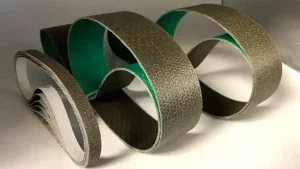
When machining titanium alloy workpieces with complex curved surfaces, manual grinding is currently mostly used. Grinding with ordinary abrasives will result in poor surface consistency of titanium alloy and low machining efficiency. If coated superabrasives tools are used, they have the characteristics of rigidity and flexibility, are less sensitive to vibration during the grinding process, and can produce workpiece surfaces with better machining quality. Commonly used ones include diamond abrasive belt, diamond flap wheel, diamond flap disc, etc.


Grinding titanium alloys places extremely high demands on grinding wheel performance, making the selection of appropriate grinding wheels and processes a top priority.Newdiamondtools has extensive experience in manufacturing CBN and diamond grinding wheels . They can provide super-abrasive grinding wheels with customized formulations tailored to different grinding requirements
Related Reading:Which IS Best ,CBN vs Sic Grinding Wheel For Titanium Alloy 2025