At present, use resin bond diamond grinding wheel for tungsten carbide tools is an important way in dry process, but the dry grinding process has a short diamond grinding wheel life and a small grinding depth. This paper introduces a wet metal bond diamond wheel for carbide tools, and explains the advantages of the wet grinding process, the adjustment of the grinding wheel gap and the process in detail, providing a reference for related enterprises and units.


About Tungsten Carbide Tools Grinding
For the grinding of carbide tools, the most widely used, advanced and effective tool is the resin bond diamond grinding wheel (vitrified bond grinding wheel is also widely used). This type of grinding wheel is usually used in dry grinding process. When grinding tungsten carbide by dry grinding process, the high temperature generated by friction cannot be dissipated in time, resulting in the maximum temperature of the friction point reaching more than 400°C, causing the resin bond to soften and the abrasive to fall off the grinding wheel.
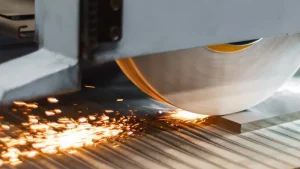
To solve the above problems, a relatively mature and advanced wet grinding process should be explored in practical production. That is using metal bond diamond wheel for carbide tools, and coolant should be used for cooling during the grinding process. After practice, the grinding depth of cemented carbide can be increased from 0.02mm in dry grinding to 3mm, and the life of the diamond wheel can be increased from 6 months in dry grinding to 3 years, giving full play to the superiority of diamond itself.
2 Structure Of Metal Bond Diamond Wheel For Carbide Tools
The diamond grinding wheel consists of a matrix, a transition layer, and a diamond layer from the inside to the outside.
Matrix: The matrix is usually made of aluminum, steel, or bakelite, and acts as a frame to support the diamond layer and transition layer.

Transition layer: The main material of the transition layer is an adhesive, which firmly bonds the diamond to the matrix.
Diamond layer: The diamond layer is a mixture of diamond and a small amount of binder, and is an important part of the grinding wheel. During the grinding process of the grinding wheel, the diamond layer grinds the parts.
3 Advantages And Disadvantages Of Wet Grinding Process And Adjustment of Grinding Wheel Gap
3.1 Advantages and disadvantages of wet grinding
The diamond layer in the wet grinding process uses a copper-based binder with greater hardness, stronger adhesion and longer life. However, due to the thermal expansion of the copper base during high-speed grinding, the gap between the diamond abrasive and the copper base is reduced or disappears, resulting in blockage and making grinding difficult.

However, the metal bond diamond wheel for carbide tools has good thermal conductivity. If coolant is added continuously during the grinding process, the grinding temperature can be greatly reduced. In addition, the copper base is squeezed during the grinding process, and the gap between the copper base and the diamond abrasive can be stabilized at 0.02-0.03 mm. This gap space is enough for the dust ground off during the grinding of cemented carbide to have enough space to accumulate, and there is also enough space for the coolant to pass through, thereby flushing and cooling the diamond layer, which can greatly increase the grinding efficiency, precision and life of the diamond grinding wheel.
3.2 Dressing Condition Of Grinding Wheel
The runout deviation of the grinding surface of a newly installed metal bond diamond wheel for carbide tools shall not exceed 0.02mm. If it exceeds this range, the grinding surface must be trimmed. The running method is to use another high-speed rotating, softer silicon carbide grinding wheel to wear and trim the diamond grinding wheel. The silicon carbide grinding wheel is consumed quickly, while the diamond grinding wheel is consumed slowly, thereby achieving the trimming of the diamond grinding wheel grinding surface.

After the grinding surface of the metal bond diamond wheel is leveled, in order to eliminate the sand surface and make the diamond abrasive protrude, the surface of the diamond wheel can be wiped with nitric acid solution (concentration 30% to 50%), and finally cleaned with clean water. The size of the protruding diamond abrasive and the size of the gap between the abrasive and the copper base can be controlled by repeatedly wiping with nitric acid solution. Usually, it can be wiped four or five times, and each time is wiped for one minute.
3.3 Splash protection device for wet grinding machine tools
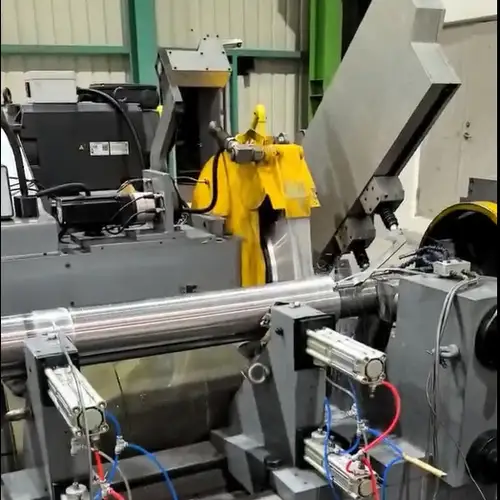
Normally, both the surface and cylindrical grinders under wet grinding process have coolant reflux devices, but tool grinders do not have coolant reflux devices due to their versatility and universality. When modifying their cooling systems, care must be taken to prevent coolant from splashing onto the electrical parts. Plastic film can be used to directly cover the parts that need to be protected, or the coolant can be poured directly onto the workpiece. When grinding, the workpiece is fed once and taper grinding is used, which can not only grind out the back angle at one time, but also improve the brightness of the back angle.


3.4 Coolant selection of metal bond diamond wheel for carbide tools
The selection of coolant should follow the principles of good cooling effect, non-toxicity, rust prevention, lubrication and flame retardancy. Soapy water and weak alkaline emulsion can usually be selected, and the flow rate should be controlled at 2 to 8 L/min.
4 Wet grinding process
4.1 Radial cutting method of metal bond diamond wheel for carbide tools
The radial cutting grinding process is to grind the workpiece using a cylindrical grinder. The machine tool is fixed and the feed depth is 2 to 3 mm at a time. The grinding width is similar to the grinding wheel width.
For example, for the grinding of the outer circle of a multi-faceted, multi-edged tool workpiece , the feed amount can be given in one go during the grinding pass: the tool is fed gently and slowly during grinding. After one circle of grinding is completed, continue to turn 2 to 3 circles, and the grinding allowance can be completely eaten up in one feed. Continue to repeat the above process and use the above method to eliminate the working allowance of other blades.

The characteristic of this method is that because both the alloy workpiece and the diamond grinding wheel are constantly rotating and grinding, the average grinding amount on each diamond abrasive of the diamond grinding wheel is negligible, and the grinding amount is about 0.01 to 0.03 mm. In this way, the grinding is the smoothest, most successful, and most efficient, and the alloy workpiece also has a high degree of finish.
4.2 Slow-moving and large-cutting depth method
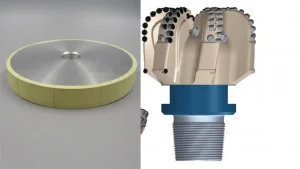
The slow-moving, deep-cut grinding method uses a bowl-shaped diamond grinding wheel. The larger the diameter of the bowl-shaped diamond grinding wheel, the greater the linear speed of the grinding wheel edge and the higher the grinding efficiency. After a bowl-shaped diamond grinding wheel has been used for a long time, an arc or slope will be generated on the edge, which increases the contact area between the workpiece and the grinding wheel, and the diamond abrasive also increases.

In addition, with the lubrication and cooling effect of the coolant, the grinding depth can reach 0.5 to 2.5 mm. The grinding depth determines the feed speed of the grinding, and the feed pressure is controlled by feel and experience. As shown in Figure 1.

5. Notes of metal bond diamond wheel for carbide tools
(1) When grinding carbide workpieces, do not grind the steel part of the workpiece. Grinding the steel part of the workpiece will not only greatly reduce the grinding efficiency, but also easily cause the diamond grinding wheel to be blocked. Therefore, when grinding the workpiece, make the steel part of the workpiece 0.5mm lower than the alloy part of the workpiece. In some workpieces with both carbide and steel, sometimes a CDX grinding wheel is a must.
(2) Each diamond grinding wheel on the machine tool should have its own mandrel. After the mandrel position is determined, it cannot be disassembled at will. If it must be disassembled, the grinding wheel and mandrel must be disassembled as a whole.
(3) The longer the cone surface of the grinder, the higher the positioning accuracy.
In the actual grinding process, because the workpieces of cemented carbide are of various types, whether it is metal, resin, ceramic, or even electroplating diamond wheel, grinding methods, dry grinding and wet grinding processes will be adopted, and grinding also needs to be carried out according to the actual situation.