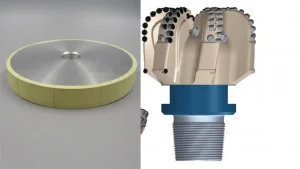
Whether it is a bowl, cup, dish or flat grinding wheel, best grinding wheel for carbide is diamond. We provide a full range of diamond grinding wheel products, with outer diameters covering 10mm to 750mm, which can meet the grinding needs of different sizes and different precision requirements, ensuring excellent processing results and long service life. The binders commonly used for grinding carbide are resin, metal, vitrified, and electroplated.


1. Selection And Parameter Analysis Of Grinding Wheel For Carbide
In tungsten carbide grinding, the reasonable selection of grinding wheels has a decisive influence on the workpiece processing quality and tool life. At present, resin bonded diamond grinding wheels have become an important solution in the industry due to their excellent comprehensive performance. Their technical advantages are mainly reflected in the following aspects:
- Excellent cutting performance: With extremely high abrasive protrusion ratio, it ensures excellent sharpness and material removal rate.
- Stable self-sharpening characteristics: Reasonable abrasive shedding mechanism, continuous cutting ability.
- Optimized chip removal design: Unique binder formula effectively prevents chip accumulation.
- Composite processing effect: Precision grinding and surface polishing at the same time.

The shape and size of the grinding wheel are also important factors to consider when choosing. It has various shapes, including cup, bowl, flat, etc., which can be customized according to actual needs. In terms of size, its outer diameter ranges from 10mm to 750mm, providing flexible options for different grinding needs.
This grinding wheel system can fully meet the needs of the entire process chain from rough machining to mirror grinding. Users can perform parameterized selection and configuration according to specific processing conditions (material grade, machining allowance, precision requirements, etc.).
2. Advantages of Diamond Grinding Wheel for Carbide
When choosing a diamond grinding wheel for carbide, the variety of shapes and sizes brings significant advantages.
In the field of tungsten precision grinding, the shape and size of the grinding wheel directly affect the processing efficiency and the quality of the finished product. Based on the geometric characteristics and processing requirements of different workpieces, we provide a full range of grinding wheel customization solutions:
1. Multi-shaped grinding wheels are suitable for various processing scenarios
Cup-shaped grinding wheels: suitable for surface grinding and end surface processing, especially suitable for precision finishing in the mold industry
Bowl-shaped grinding wheels: excellent in tool fluting and complex surface grinding
Flat grinding wheels: as a general-purpose grinding tool, widely used in basic processing such as cylindrical grinding and surface grinding.


Secondly, in terms of size, the outer diameter of the grinding wheel ranges from 10mm to 900mm, providing users with great flexibility to adapt to a variety of different grinding needs. These advantages make the grinding wheel an indispensable and important tool in grinding work.
Precautions During The Production Process Of Resin Diamond Wheel
- Select high-quality diamond abrasives and carefully combine them with imported resin binders to ensure high product quality.
- During the production process, strict supervision and control are carried out, and the quality inspection department will also re-inspect the products to double guarantee product quality.
- According to customer needs, we customize production and use special special formulas to ensure excellent grinding effect, high grinding efficiency and long service life.
In addition, the grinding wheel for carbide produced have special formulas, covering multiple categories, coarse grinding, fine grinding and fine grinding to meet the diverse needs of needs.
3. Common Application Scenarios
3.1. Application in corrugated industry:
The special grinding wheel for carbide we launched uses super-hard abrasive synthetic diamond as the key component, which is perfectly suitable for thin knives made of tungsten steel (carbide YG8 and other models). By using the resin bond that is most suitable for thin knives, the grinding wheel always maintains excellent grinding performance. In addition, we also provide a variety of grit options to adapt to different materials and grinding needs.
For example, 80#-120# grit is recommended for the rough grinding stage,
120#-180# for the semi-fine grinding stage
180#-W40 and W40-W1 for the fine grinding and grinding and polishing stages respectively.
For tungsten steel thin knives, the mirror finish is high and the grinding accuracy requirements are strict, so it is recommended to choose within the 180#-240# grit range. At the same time, we carefully match the different density grinding wheel organizations to further optimize the grinding accuracy and heat dissipation performance.
3.2. Diamond Grinding Wheel For Carbide Milling Cutter Industry:
When grinding carbide milling cutters, diamond resin grinding wheels are the first choice. According to the different grinding parts and requirements of the milling cutter, we will choose the corresponding grinding wheel shape,At the same time, in response to the grinding needs of different milling cutter parts, we provide a variety of particle sizes from 80# to 320# to meet the full process from rough grinding to fine grinding.

3.3 Diamond Grinding Wheel for Cabide Woodworking Industry
3.3.1 Changes in woodworking processing methods and the popularization of carbide tools
In recent years, with the improvement of CNC technology, automation equipment and high-precision processing needs, the processing methods of the woodworking industry are undergoing profound changes. Traditional high-speed steel (HSS) tools have gradually been replaced by high-performance carbide (tungsten steel) tools due to their insufficient wear resistance and short life. According to statistics, carbide tools account for more than 75% of the woodworking tool market, with an annual growth rate of 8%-10%, becoming the mainstream choice in the industry.
In the furniture manufacturing, floor processing, wood-based panel production and architectural decoration industries, various types of carbide tools are widely used, mainly including:

Carbide circular saw blade (Φ80mm-600mm): used for cutting and slicing wood, requiring sharp and wear-resistant edges;
Floor blade (molding blade): used for mortise and tenon processing of solid wood floors and laminate floors, requiring high-precision contours;
Finger joint blade: used for wood splicing, requiring extremely high requirements for edge straightness and smoothness;
Line blade (molding blade): used for special-shaped processing such as door frames and skirtings, requiring both complex blade shapes and wear resistance.
Due to the fiber structure characteristics of wood, the cutting tool is prone to chipping and wear during high-speed cutting. Therefore, it is necessary to rely on high-precision diamond grinding wheels for regular grinding to restore the cutting performance of the tool.。
3.3.2 Key technologies of diamond grinding wheel for carbide woodworking industry
In order to meet the grinding wheel for woodworking industry’s demand for high efficiency and high precision in tool grinding, we use a multi-process collaborative optimization approach to ensure that the grinding wheel has excellent grinding performance:
Special bond formula design
In view of the grinding characteristics of woodworking tools (such as light load and high speed), we optimized the composition ratio of the resin binder and used modified phenolic resin + nano-enhanced filler to improve the durability of the grinding wheel while maintaining high sharpness. Test data shows that compared with the traditional formula, the grinding wheel life of the new formula can be increased by more than 30%.

Precision abrasive distribution technology
The orderly arrangement process is adopted to ensure that the diamond abrasive particles (particle size range 80#-600#) are evenly distributed to avoid the problem of tool edge breakage caused by local wear. Experiments show that the optimized diamond grinding wheel can reduce the surface roughness (Ra) of the workpiece to below 0.2μm, significantly improving the quality of the tool edge.
Dynamic balance and structural optimization
In response to the grinding needs of large-sized woodworking tools (such as circular saw blades above Φ500mm), the grinding wheel adopts a high-rigidity matrix + low-density structure design to ensure stability during high-speed grinding (linear speed ≥35m/s), and the radial runout is controlled within 0.01mm.
3.3.3 Actual application effects and market feedback
Through rigorous working condition tests (such as wear detection after 1,000 continuous grindings), our diamond grinding wheels for tungsten carbide have shown the following advantages:

Grinding efficiency increased by 20%: thanks to high abrasive holding force, the material removal rate (MRR) can reach 15mm³/s;
Tool life extended by 40%: the cutting edge can still maintain its original accuracy after repeated grinding;
Overall cost reduction: the cost of a single grinding is 30%-50% lower than that of imported grinding wheels.
At present, our products have been widely used by well-known woodworking machinery manufacturers in China and exported to Southeast Asia and Europe, with annual sales exceeding 500,000 pieces and customer satisfaction exceeding 98%. In the future, we will continue to develop more efficient grinding solutions for emerging needs such as super-hard tools and composite material processing.